
What Is Anti-Reflection Coating on Camera Lenses
Introduction
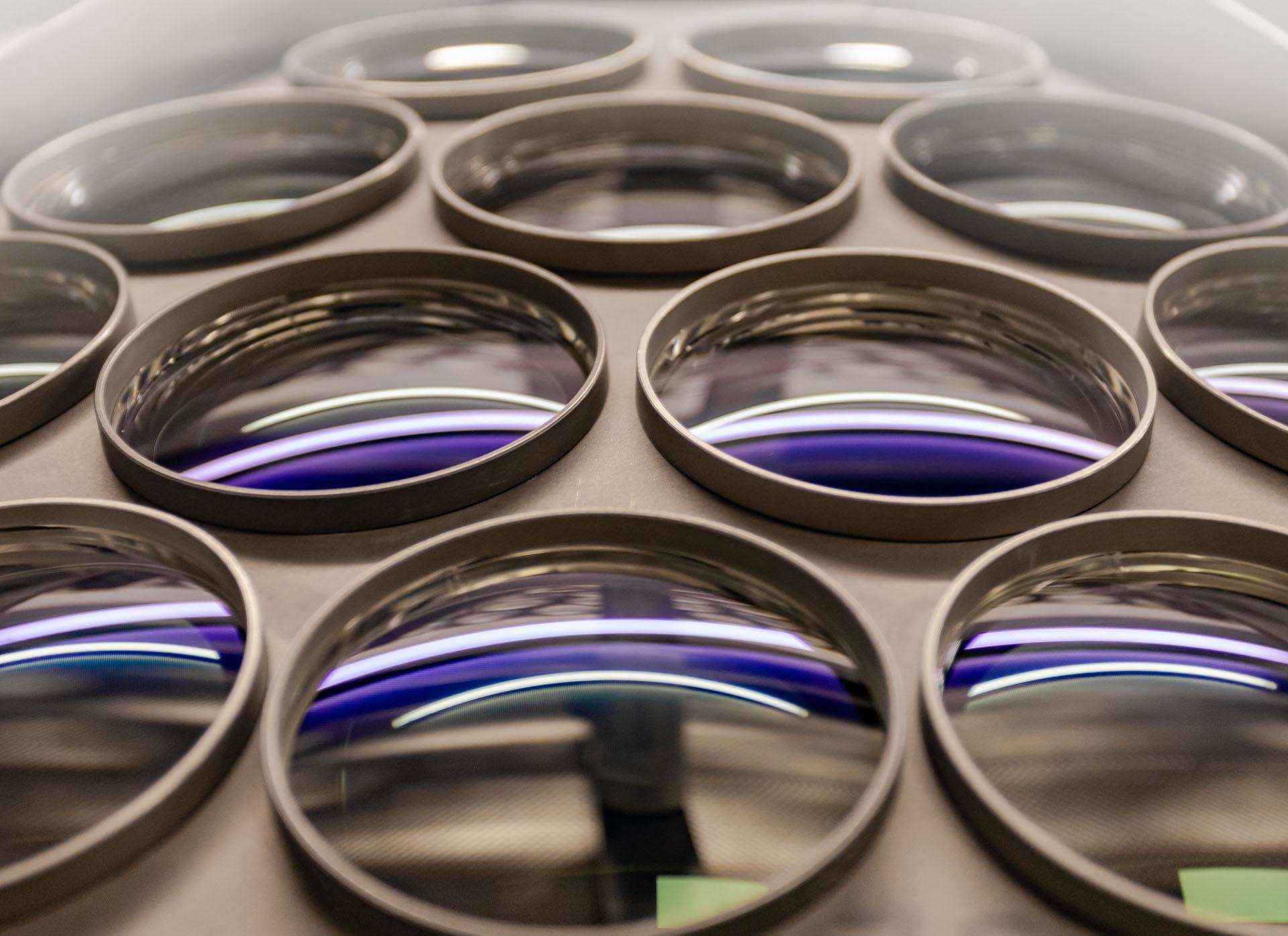
Look at a coated camera lens under a light source. You may see subtle blue, green, purple, or amber reflections. That color is often associated with anti-reflection coating, but the coating's purpose is not decoration. It controls how much light is reflected at optical surfaces. Every material boundary reflects some light; in multi-element lenses, reflections can reduce transmission and create secondary images, flare, or contrast loss. AR coating is a key technology for improving optical transmission and imaging quality. The appropriate design depends on wavelength, angle, lens materials, application, and cost.
1. Why Optical Surfaces Reflect Light
When light travels from air into glass or another optical material, a portion is transmitted and a portion reflected. The amount depends primarily on refractive indices and angle of incidence. An uncoated glass surface can reflect several percent under typical conditions. A lens contains multiple surfaces, so these losses can accumulate. Reflected light may also travel through unintended paths and reach the sensor as ghost images or veiling glare, reducing contrast—particularly near bright sources.
2. How Anti-Reflection Coating Works
A basic AR coating uses thin-film interference. A thin material layer is deposited on an optical surface. Reflections from the top and bottom boundaries can interfere. With suitable thickness and refractive index, reflected waves partially cancel at selected wavelengths and angles, reducing reflection and increasing transmission. Modern coatings often use multiple layers with different refractive indices and carefully controlled thicknesses to improve performance over a broader spectral range. They are not necessarily zero-reflection at every wavelength or angle; they are optimized for the application's conditions.
3. Single-Layer vs. Multilayer Coatings
Single-layer coatings can provide useful reflection reduction near a design wavelength or within a limited spectral range. They may suit specific wavelength requirements or cost constraints. Multilayer coatings offer greater flexibility and can be designed for lower reflectance across visible wavelengths or selected near-infrared bands. They may also account for angle of incidence and optical materials. More layers do not automatically mean better performance: the design must match the actual spectral and angular requirements.
4. AR Coating, Ghosting, and Flare
Ghosting occurs when reflected light creates secondary images or artifacts. Flare can appear as haze, streaks, or reduced contrast caused by stray light. AR coatings reduce reflections at optical surfaces and can lower ghosting risk, especially when a camera views lamps, headlights, or other high-contrast sources. Coating is only one part of flare control. Optical design, aperture, surface quality, barrel geometry, and internal blackening also matter. Evaluate the complete lens under realistic lighting.
5. Visible, Near-Infrared, and Broadband Coatings
Visible camera lenses are commonly optimized for the visible spectrum. Day/night surveillance systems may also operate in near-infrared; lens and filter configuration should be evaluated across intended bands, particularly when the camera switches between color and IR modes. Thermal imaging works at much longer wavelengths and uses different materials and coating technologies. A visible-light coating should not be assumed to work well for thermal imaging. Specify wavelength range and transmission or reflectance targets.
6. What Buyers Should Specify
Avoid specifying only a coating color such as blue or green. Visible color is not a reliable performance specification. Useful requirements include operating wavelength, target transmission or reflectance, incidence angle where relevant, substrate, environmental requirements, cleaning or abrasion expectations, and application concerns such as flare or ghosting. The coating should be evaluated as part of the optical design. A surveillance lens may need reflection control under point sources, while a machine-vision lens may prioritize stable transmission under controlled illumination.
7. Coating Quality and Manufacturing Consistency
Coating performance depends on material selection, deposition process, layer-thickness control, cleanliness, and inspection. Uniformity across production can be important for camera manufacturers requiring consistent image quality. Validation may include spectral transmission or reflectance measurements, visual inspection, and environmental testing according to project requirements. A repeatable, measurable coating specification is more useful than a visual color description alone.
Boshi Optics: Coating as Part of the Lens System
Boshi Optics provides optical lens design and manufacturing solutions for security cameras, automotive imaging, medical devices, AIoT, drones, and other applications. Optical processing, lens assembly, and testing capabilities support lenses for different sensors and operating conditions. For customized projects, coating requirements can be discussed alongside focal length, aperture, sensor format, field of view, operating wavelength, mechanical dimensions, and environmental conditions. This integrated approach helps ensure coating supports the intended imaging performance.
Conclusion
Anti-reflection coating reduces unwanted surface reflections, improves light transmission, and helps control ghosting and contrast loss. Single-layer and multilayer coatings serve different requirements. The best choice depends on wavelength, angle, materials, environment, and application. For camera manufacturers, the practical question is not simply whether a lens has coating, but whether it has been designed and verified for the system's operating conditions.