
Why an F1.0 Lens is the Secret to Full-Color Night Surveillance | Shanghai Silk Optical
The Math of Light: Why F1.0 is a Massive Leap, Not a Baby Step
When buying or manufacturing security equipment, it is easy to look at an F2.0 lens and an F1.0 lens and think, "It's just a 1.0 difference, right?" Wrong. In the world of optics, f-numbers don't scale linearly. The f-number (or focal ratio) is the ratio of the lens's focal length to the diameter of the entrance pupil. The formula for the light-gathering power (illuminance) of a lens dictates that the amount of light hitting the sensor is inversely proportional to the square of the f-number:
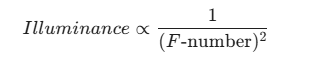
So, if we compare an F2.0 lens to an F1.0 lens, the calculation for the difference in light intake looks like this:

An F1.0 lens doesn't give you twice the light of an F2.0 lens—it gives you exactly four times the light. Imagine trying to catch rain in a bucket. Upgrading to F1.0 is like swapping your standard bucket for a kiddie pool. When you funnel four times the amount of ambient photons (from streetlights, the moon, or distant buildings) onto a modern Starlight-level sensor, the camera's image signal processor (ISP) doesn't have to artificially boost the gain.
-
Low Gain = Low Noise: You get a clean, sharp image without that annoying digital "snow."
-
High Light = Full Color: The sensor receives enough wavelength data to accurately render colors, even in the middle of the night.
The Catch: Why You Can't Just Make Any Lens "F1.0"
If F1.0 is so great, why isn't every camera equipped with one? Because bending that much light accurately is incredibly difficult.
When you open up an aperture that wide, you invite optical chaos: light rays hitting the edges of the lens cause chromatic aberration (purple fringing) and severe blurring at the corners of your image. To control an F1.0 aperture, the internal structure of the lens must be masterfully engineered.
This is where the distinction between cheap plastic lenses and professional-grade glass becomes critical.
Enter the PL100: The Power of the 7E Structure
At Shanghai Silk Optical Technology Co., Ltd., we designed the PL100 Lens specifically to solve the F1.0 engineering challenge for high-end security and robotics applications.
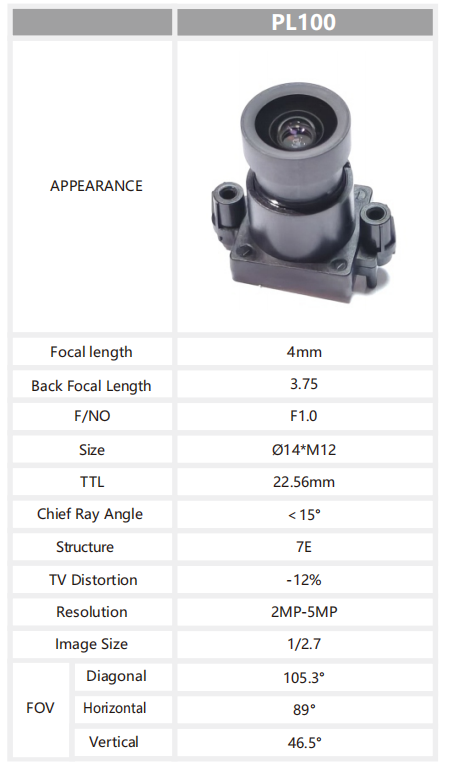
Achieving a 2MP-5MP resolution with an F1.0 aperture on a 1/2.7 sensor requires intense precision. You cannot achieve this with standard plastic elements. The PL100 utilizes a 7E (Seven Elements) All-Glass Structure. Here is why that matters to your bottom line:
-
Unmatched Transmittance: Glass allows more light to pass through than plastic. When the entire goal of an F1.0 lens is to maximize light intake, using plastic elements defeats the purpose. The 7E glass structure ensures the maximum amount of those captured photons actually makes it to the sensor.
-
Supreme Thermal Stability: Security cameras live outdoors. They bake in the summer sun and freeze in the winter. Plastic lenses expand and contract with temperature changes, slightly shifting the focal point and causing your perfectly sharp camera to become blurry over time (a phenomenon known as thermal drift). Glass is incredibly stable. The PL100's 7E construction ensures that your 4mm focal length stays exactly at 4mm, whether it's 40°C or -20°C.
-
Edge-to-Edge Clarity: With a wide Horizontal FOV of 89°, the 7 precisely aligned glass elements correct the optical distortion inherently caused by the massive F1.0 aperture, keeping the edges of your footage as sharp as the center.
The Verdict for Purchasing Managers and Engineers
Moving to full-color night surveillance isn't a gimmick; it is the new standard for the security industry. But throwing a high-end Starlight sensor behind a cheap, narrow-aperture lens is like putting a sports car engine in a golf cart.
To truly unlock "color without supplementary light," you need the 4x light-gathering power of an F1.0 aperture, backed by the thermal stability and high transmittance of an all-glass structure.
(Ready to upgrade your hardware lineup? Explore the full specifications of the PL100 and our other precision optical lenses here.)