
Say Goodbye to "Fill Light Pollution": How F1.0 Black Light Lenses Optimize Smart Parking LPR
Say Goodbye to "Fill Light Pollution": How F1.0 Black Light Lenses Optimize Smart Parking LPR
Article Introduction We have all experienced it: You pull up to a smart parking lot boom gate at midnight, and suddenly, a high-intensity white LED spotlight blasts you right in the retinas. You are temporarily blinded, the gate goes up, and you drive away squinting.
This is known as "Fill Light Pollution," and it is the bane of modern smart parking lots, residential communities, and toll booths.
For years, system integrators relied on these blinding white lights to help security cameras read license plates in the dark. But what if we told you those lights are not just annoying to drivers—they might actually be lowering your License Plate Recognition (LPR) success rates?
The future of smart parking doesn't require more watts of LED power; it requires better optics. Here is why upgrading to an F1.0 Black Light Lens is the ultimate solution for optimizing your LPR/ANPR systems.
The LPR Paradox: Why More Light Doesn't Mean Better Recognition
License plates are inherently highly reflective. They are designed to bounce headlights back at the driver.
When a smart parking camera uses a powerful white LED fill light at a close range (like a parking gate), that intense light hits the reflective license plate and bounces straight back into the camera lens. This causes overexposure or glare. The characters on the plate get washed out in a sea of bright white pixels, making it impossible for the AI software to read the numbers.
To fix this, engineers try to dim the light, which then makes the surrounding car too dark to identify the make or model. It is a no-win situation.
The smartest way to read a license plate at night is to use the ambient light that is already there—streetlamps, the car's own headlights, or moonlight. But to do that, you need a camera lens that acts like a massive funnel for photons.
The F1.0 "Black Light" Revolution
This is where the F1.0 large aperture lens changes the game.
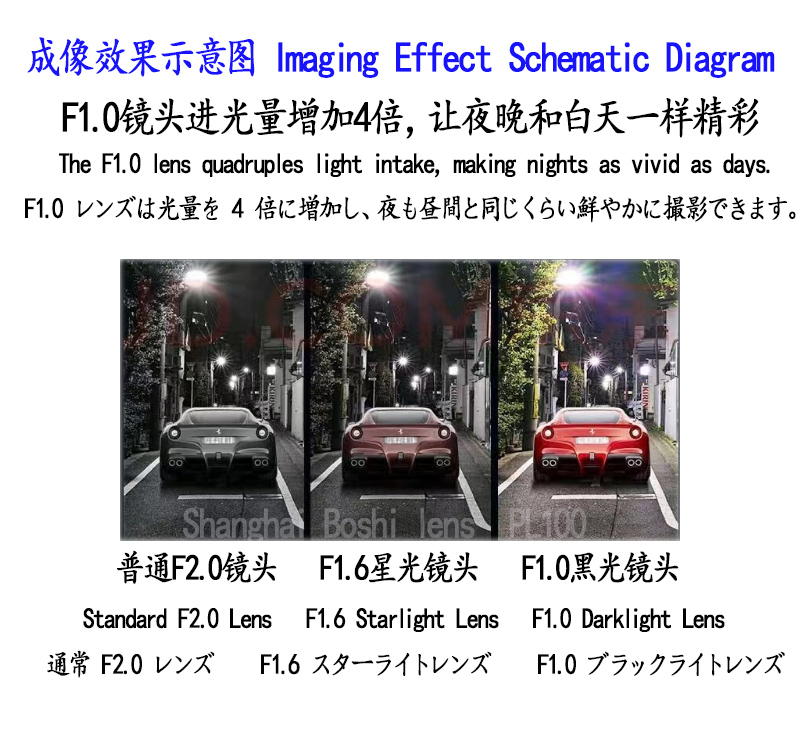
As we've discussed in optical engineering, aperture determines light intake. The leap from a standard F2.0 security lens to an F1.0 lens isn't a small step; it physically quadruples (4x) the amount of light hitting the sensor.
When you pair an F1.0 lens with a modern high-sensitivity "Starlight" or "Black Light" image sensor, the camera can "see" the license plate perfectly in full color using only ambient light.
-
No more blinding white LEDs.
-
No more washed-out, overexposed license plates.
-
Happy drivers, unbothered neighbors, and a 99%+ LPR success rate.
Why Glass is Non-Negotiable for LPR: The PL100 Advantage
Recognizing a license plate requires absolute edge-to-edge sharpness. If the letter "B" looks like an "8" because the lens is slightly out of focus, the boom gate stays down.
This is why you cannot use cheap, plastic-element lenses for outdoor LPR applications. Cameras at parking gates bake in the summer heat and freeze in the winter. Plastic lens elements expand and contract with temperature changes (thermal drift), causing the license plate to drift out of focus.
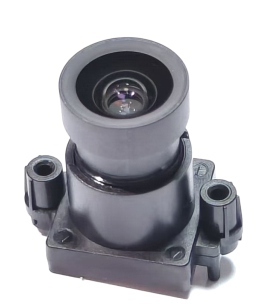
At Shanghai Silk Optical Technology Co., Ltd., we engineer lenses specifically to handle these harsh, high-precision environments. The PL100 M12 Lens is the perfect blueprint for an LPR gate camera:
-
Massive F1.0 Aperture: Captures enough ambient light to turn off the blinding LED spotlights for good.
-
7E (Seven Element) All-Glass Structure: Glass boasts supreme thermal stability. Whether it is a scorching 40°C afternoon or a freezing -10°C night, the PL100’s focal point remains locked, ensuring the plate characters are always razor-sharp.
-
Optimal 4mm Focal Length: Specifically tailored for the standard distance of a car pulling up to a parking gate or toll booth, providing a clear, distortion-free view (-12% TV distortion) of the vehicle's front end.
-
High Resolution: Perfectly resolves 2MP to 5MP sensors, feeding your AI recognition software the crisp pixel data it needs to perform flawlessly.
The Bottom Line for System Integrators
If your parking lot projects are still relying on retina-burning white LEDs to get a decent read on a license plate, you are utilizing outdated tech. Upgrading to a true F1.0, all-glass optical setup isn't just a courtesy to drivers; it is a fundamental hardware upgrade that directly increases the accuracy and reliability of your entire LPR system.
(Ready to eliminate fill light pollution in your next parking lot project? Check out the F1.0 Blacklight lens specifications and request an evaluation sample today.)