
F1.0 vs IR: Which Low-Light Lens Fits Your Project?
As an optical engineer at Shanghai Silk Optical, my day-to-day reality consists of fighting refractive indices, scraping for fractions of a percent on MTF curves, and arguing about raw material bills. I see far too many product lines fail in field testing because a procurement team swallowed a generic sales pitch hook, line, and sinker. "F1.0 is the future," they tell you. Or "IR is cheap and indestructible."
Don't buy into the hype. Optical design is an unyielding game of physical trade-offs. Let's look past the marketing PPTs and break down what actually happens to your imaging pipeline when you choose one over the other.
1. F1.0 "Blacklight" Full Color: The Photon Monster (And Its Hidden Tax)
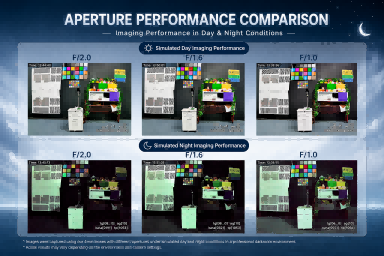
The entire premise of active low-light full-color tech hinges on the F1.0 aperture.
If you aren't an optics geek, here is the quick math: the F-number is the ratio of the lens's focal length to its entrance pupil diameter. Every time you drop an F-stop, you double the light reaching the sensor. Moving from a standard F2.0 lens to an F1.0 means you are dumping four times more light onto your CMOS pixels.
In real-world deployment—say, a patrol AMR navigating a dimly lit logistics yard—this means you don't need intrusive, blinding white LED glare to capture full-color, high-contrast video. For AI models that depend on chromatic data to classify objects (like identifying a suspect's jacket color or a hazard sign), F1.0 is spectacular.
But here is the catch that amateur suppliers won't tell you: wide-open apertures introduce absolute chaos to optical aberrations.
When you open the iris to F1.0, light rays strike the outer edges of the lens elements at incredibly steep angles. This triggers two massive problems:
-
Razor-Thin Depth of Field (DoF): Your margin for error drops to millimeters. If your mechanical housing flexes even slightly due to solar heat, your target drifts completely out of focus.
-
Peripheral MTF Collapse: Spherical aberration and coma will turn the corners of your image into a muddy, unusable soup.
To counteract this, we can't just use cheap, off-the-shelf spherical glass. We have to design around ASP (Aspherical Lens) elements to force those rogue edge-rays back into a single focal point.
Actually, let let me rephrase that—it’s not just about using aspherical shapes; it's about the material choice. If you buy a cheap, all-plastic F1.0 lens, it will fail the moment ambient temperatures hit 40°C. At Silk Optical, we stabilize these massive apertures using glass-plastic hybrid architectures (like our 2G3P or multi-glass formulations) coupled with strict Temperature Compensation structural engineering. If your vendor isn't talking about thermal drift while quoting an F1.0 lens, walk away.
2. Infrared (IR) Night Vision: The Cost-Effective Workhorse (With a Wavelength Trap)
On the other side of the fence, we have traditional IR illumination (typically paired with 850nm or 940nm active IR LEDs). Lenses in this category—like our high-volume PL071 4MP-8MP 6G All-Glass series—are incredibly mature, highly stable, and exceptionally friendly to your procurement budget.
The main advantage of an IR system is uncompromising contrast. In absolute zero-lux environments—underground tunnels, unlit rural perimeters—IR turns the world into high-contrast black-and-white. It strips out color confusion, giving edge AI algorithms razor-sharp profiles and boundaries to trace.
However, there's a silent killer waiting in IR setups: Focus Shift.
A common, frustrating scenario: Your R&D team calibrates a camera system in the lab during the day. It looks incredibly sharp. Night falls, the active IR illuminators kick on, and suddenly the feed looks like someone smeared grease over the lens.
"Actually, scratch that—don't blame the sensor's noise reduction. It’s fundamental physics."
Visible light (400–700nm) and Infrared light (850nm/940nm) travel at different speeds through the same glass medium because the refractive index shifts based on wavelength. If your lens elements aren't deliberately optimized for IR Co-focus, the focal plane for visible light and the focal plane for IR light will land on two completely different depths behind the lens.
To bypass this nightmare, we integrate ED (Extra-low Dispersion) Glass elements and utilize complex multi-layer broadband anti-reflective coatings. Furthermore, during assembly at our Boshi Intelligent Technology Park, every single unit passes through automated SMA (Small Medium Aperture) active alignment machines to verify multi-wavelength MTF response. Without true IR co-focus engineering, your night vision system is just a gamble.
3. The Sourcing Blueprint: Which One Fits Your Matrix?
Let’s strip away the corporate fluff and condense this into a concrete, deployable decision matrix for your engineering team.
Pull the trigger on F1.0 Blacklight Full Color if:
-
Color is non-negotiable: Your software requires chromatic signatures for analytics (e.g., license plate recognition, multi-colored asset tracking, facial feature extraction).
-
Active illumination is banned: Your system operates in areas where bright white light or visible infrared glow causes public disturbance, attracts insects, or compromises stealth.
-
High-density Edge AI accuracy is paramount: Your neural network requires maximum Signal-to-Noise Ratio (SNR) per pixel without relying on heavy temporal noise reduction software filters that introduce ghosting artifacts.
-
Sourcing Mandate: Insist on glass-plastic hybrid or all-glass builds with integrated ASP elements and documented thermal drift tolerance specs spanning -20°C to +70°C.
Stick to Infrared (IR) Night Vision if:
-
The budget is strictly capped: You are deploying thousands of nodes (like standard warehouse surveillance or low-tier vacuum robot bumpers) and cannot absorb the premium cost of multiple aspherical glass elements.
-
You operate in true Zero-Lux environments: There is zero ambient light or urban skyglow to harvest, making a passive F1.0 lens useless without active white light assistance.
-
Geometry matters more than color: Your system relies purely on geometric contours, edge detection, or vision-based SLAM spatial mapping.
-
Sourcing Mandate: Verify that the lens spec explicitly guarantees IR Co-focusing capabilities and features robust internal flare suppression (such as Blue Glass or specialized rear-element masking) to block internal IR bounceback.
Scaled Precision Without the Fluff
At Shanghai Silk Optical, we don't believe in selling one-size-fits-all solutions. Operating out of our state-of-the-art manufacturing hub, we maintain an automated production capacity exceeding 6 million lenses per month. We bridge the gap between high-end optical physics and ultra-stable global supply chain delivery, backed by ISO9001:2015 and IATF16949:2016 automotive-grade certifications.
Whether your R&D engineers need custom-tailored F1.0 wide-angle glass for an autonomous delivery drone or a highly cost-optimized 5MP IR lens for an industrial production line, we deliver the raw data first.
Bring us your sensor specs and your Chief Ray Angle (CRA) requirements. Let’s look at the actual MTF curves and build something that works in the dirt, not just on a whiteboard.