

Why F1.0 Large Aperture Is the Real Engine Behind Black Light Full-Color Surveillance
First, Let’s Kill a Common Misconception
A lot of buyers still think black light imaging is mainly about the sensor.
It’s not. Or at least, not anymore.
Modern CMOS sensors—especially in the 1/1.8", 1/2.7", and 1/2.8" classes—have improved dramatically in quantum efficiency and backside illumination performance. Frankly, most decent surveillance sensors today are already capable of respectable low-light response.
The bottleneck has shifted.
The real constraint now is optical throughput.
Meaning: how efficiently the lens transfers available light onto the sensor plane.
And this is exactly why F1.0 matters.
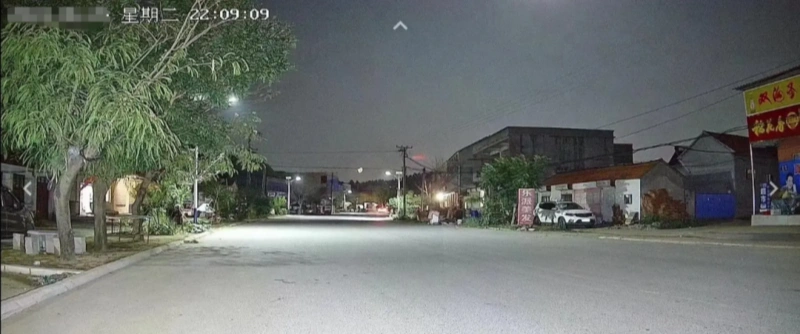
F1.0 Is Not “Slightly Better” Than F1.6
This part gets underestimated constantly.
People see:
- F1.6
- F1.4
- F1.2
- F1.0
…and assume the difference is incremental.
Actually, scratch that — let’s look at the physics side first.
The F-number is inversely proportional to the entrance pupil diameter. Light transmission scales approximately with the square relationship.
So compared with an F1.6 lens, an F1.0 optical system can theoretically deliver over 2.5× more light to the sensor.
That is not a small improvement.
That is the difference between:
- usable color imaging
- and monochrome failure.
Or between:
- 1/15s exposure blur
- and stable motion capture.
Or between:
- AI correctly identifying a human silhouette
- and confidently classifying a bush as a vehicle.
Engineers working on real deployments know this already. Especially in logistics parks, city streets, or low-illumination industrial zones where adding supplemental white light becomes politically or operationally problematic.
Why “Full-Color at Night” Is Actually an Optical Problem
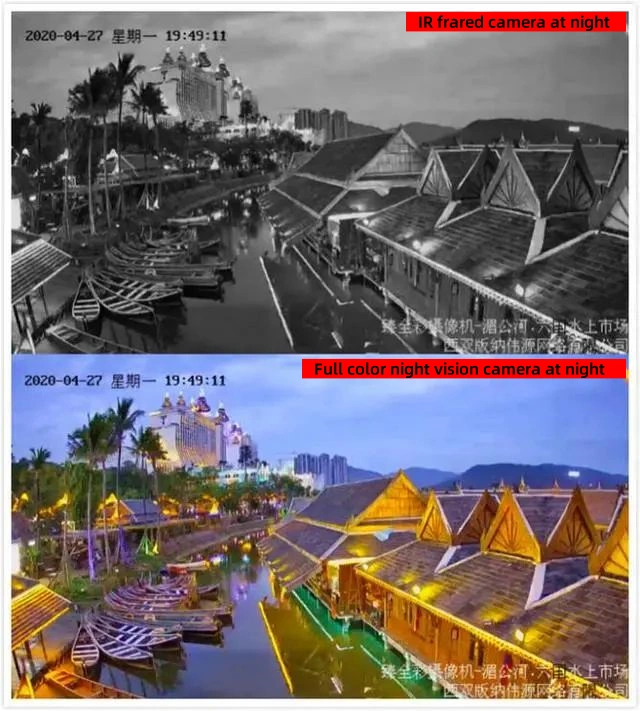
Marketing teams love the phrase “full-color night vision.”
What they usually don’t explain is how brutally difficult it is optically.
To maintain color information in near-dark environments, the system must preserve sufficient signal-to-noise ratio across RGB channels simultaneously.
That means the lens must:
- maximize photon intake
- minimize flare
- suppress ghosting
- maintain high MTF under low contrast conditions
- control chromatic aberration
- preserve edge illumination
- maintain IR co-focus consistency
And unfortunately, large aperture design makes all of these harder.
This is the part many low-cost lens suppliers conveniently skip.
Building a true F1.0 surveillance lens is not simply “making the hole bigger.”
A large aperture dramatically increases aberration management difficulty:
- spherical aberration
- sagittal coma
- field curvature
- astigmatism
- axial chromatic shift
All become more aggressive.
Especially at the edge field.
And once you move into 5MP or 8MP imaging? The tolerance window gets ugly fast.
A lens that looked “acceptable” at 2MP suddenly collapses under higher pixel density.
The Hidden Enemy: Edge Performance
Here’s something procurement teams often discover too late:
A low-light camera can look fantastic in the center… and terrible at the edges.
Why?
Because wide-aperture optical systems naturally struggle with off-axis imaging performance.
This becomes especially problematic in:
- parking surveillance
- perimeter monitoring
- warehouse coverage
- UAV night inspection
- robotic navigation
In these applications, edge detail matters as much as center detail.
If facial detail smears at the corners or license plates collapse under low lux conditions, the system fails operationally—even if the center image looks bright.
This is why advanced F1.0 lens systems increasingly rely on:
- multi-aspherical architectures
- low-dispersion glass
- hybrid glass-plastic groups
- tighter CRA control
- precision active alignment
At Shanghai Silk Optical, our black light lens systems use advanced multi-element optical structures including 7-element architectures for high-transmission low-light imaging.
And honestly? Even with modern tooling, large-aperture optimization is still one of the most annoying balancing acts in optical engineering.
You improve corner brightness and suddenly distortion rises.
You suppress coma and MTF shifts.
You tighten CRA and sensor compatibility changes.
There is no free lunch in lens design.
CRA Matching: The Problem Almost Nobody Explains Properly
Let’s talk about Chief Ray Angle (CRA).
Because this quietly determines whether your expensive sensor performs properly or not.
Modern CMOS sensors—particularly high-resolution backside illuminated sensors—have strict angular acceptance behavior.
If the incoming ray angle exceeds sensor tolerance:
- edge shading increases
- color shift appears
- sensitivity drops
- corner noise rises
This becomes catastrophic in ultra-wide low-light systems.
Especially below F1.4.
A poorly optimized F1.0 lens can actually produce worse real-world performance than a properly engineered F1.6 system.
Yes, really.
This is why low CRA design becomes critical in modern black light optics. Some advanced surveillance lenses now maintain CRA below ~12° to improve sensor coupling efficiency.
And yet many buyers still compare lenses using only:
- focal length
- F-number
- price
That’s a dangerous oversimplification.
IR LEDs Are Not Always the Answer
There’s also an industry shift happening here.
Traditional IR night vision still works. Nobody’s arguing otherwise.
But IR-assisted surveillance creates its own problems:
- reflective hotspots
- limited identification distance
- loss of color information
- insect attraction
- overexposed foreground objects
- AI recognition inconsistencies
In smart-city deployments, visible-light pollution regulations are also becoming stricter in some regions.
So the industry has been moving toward black light full-color systems that rely more heavily on ambient illumination:
- moonlight
- urban spill light
- storefront lighting
- roadway illumination
And this transition makes ultra-large aperture optics far more important than they were five years ago.
Frankly, the lens is becoming the primary low-light amplifier of the entire imaging chain.
The F1.0 Engineering Tradeoff Nobody Likes Discussing
Here’s the part marketing brochures usually avoid.
F1.0 lenses are harder to manufacture consistently.
Much harder.
Tolerance sensitivity increases dramatically:
- decentering
- tilt
- coating inconsistency
- injection molding deviation
- assembly stress
- temperature drift
All become magnified.
A mediocre assembly process will destroy low-light performance long before the optical design itself reaches theoretical limits.
This is why high-volume consistency matters as much as the optical prescription.
Automated MTF sorting, active alignment, temperature compensation design, and precision molding control are no longer “premium extras.” They are survival requirements for scalable black light production.
And honestly, this is where many ultra-low-cost optics fail quietly in the field.
Not in the lab.
Not in marketing demos.
But six months later in real outdoor environments.
Black Light Surveillance Is Pushing Lens Design Into a New Era
The shift toward:
- 5MP+
- AI analytics
- full-color night imaging
- edge AI processing
- smart traffic systems
- autonomous security robots
…is forcing lens engineering to evolve faster than many people expected.
Because once sensors crossed a certain sensitivity threshold, optics became the limiting factor again.
History repeats itself.
And right now, F1.0 large-aperture systems sit at the center of that transition.
Not because “bigger aperture sounds premium.”
But because modern surveillance increasingly depends on extracting usable visual intelligence from almost no light at all.
That’s an optical challenge first.
Everything else comes later.
About Shanghai Silk Optical
Shanghai Silk Optical Technology Co., Ltd. specializes in precision optical solutions for:
- security surveillance
- automotive imaging
- medical optics
- robotics vision systems
- UAV imaging
- smart home cameras
- LiDAR and projection optics
The company operates a vertically integrated manufacturing chain covering:
- optical lens processing
- precision mold manufacturing
- injection molding
- automated assembly
- MTF inspection and sorting
with monthly lens production capacity exceeding millions of units.