
Raw Material Price Fluctuation Warning: Tightening Supply of High-Refractive-Index Glass and Its Impact on Q3/Q4 Lens Costs
The Hard Data: What is Driving Up Optical Glass Costs?
The cost of producing precision optical glass has been steadily climbing since late 2025. This is not anecdotal; it is reflected across multiple industrial tracking metrics.
1. The Overall Glass Manufacturing Index is Climbing According to the U.S. Producer Price Index (PPI) for Glass and Glass Product Manufacturing, the index has seen a notable and steady increase. In December 2025, the index sat at 177.29. By March 2026, it had climbed to 182.42. This establishes a clear baseline: the energy and baseline material costs to operate glass melting furnaces are increasing globally.
2. The Rare-Earth Dopant Squeeze Standard flat glass relies heavily on silicon dioxide and soda ash. However, precision M12 lenses require high-refractive-index glass (often exceeding an index of n > 1.7 or 1.8). To achieve these optical properties without making the glass incredibly thick, manufacturers must dope the glass with rare-earth elements, most notably Lanthanum.
Recent industry reports from April 2026 highlight that fluctuations in rare-earth dopants used for high-index properties have disrupted supply chains, increasing costs for specialized high-index substrates by up to 20% in recent quarters.
While raw Lanthanum prices in Northeast Asia have hovered around $2.76 to $2.87 per kilogram in early 2026, the global restructuring of rare-earth supply chains (as Western nations attempt to build alternative processing facilities) has created localized shortages and longer lead times for the midstream foundries that actually mix and press the optical glass blanks.
Why HRI Glass is Non-Negotiable for Modern Lenses
You might ask: Why not just use standard, cheaper silicate glass?
The answer lies in optical physics. As sensor resolutions increase to 5MP and physical pixel sizes shrink, lenses must fiercely correct for chromatic aberration (color fringing) and maintain a very low Chief Ray Angle (CRA < 15°). If you try to bend light sharply using standard glass, the light splits into a rainbow, ruining the image data for AI-ISP algorithms. Lanthanum-based high-refractive-index glass allows engineers to bend light efficiently within a very compact space (like an M12 barrel) while keeping the different wavelengths of light perfectly aligned.
In short: You cannot build a modern, high-performance F1.0 or compact 5MP lens without HRI glass elements.
The Q3/Q4 2026 Cost Projection
If you are a system integrator relying on traditional 7E (Seven Element) All-Glass lenses for standard security or robotics applications, you need to prepare for margin compression in Q3 and Q4.
As the 20% premium on rare-earth doped HRI glass works its way from the glass foundries (like Schott or Hoya) down to the lens manufacturers, the cost to produce heavy, all-glass M12 units will inevitably rise. Suppliers will be forced to either pass these material costs onto you or quietly downgrade the glass types, which will instantly cause your edge resolution to drop.
Strategic Mitigation: The Advantage of Hybrid Structures
The most effective way to protect your Q3/Q4 procurement budget from HRI glass price spikes is to re-evaluate your mechanical optical structures.
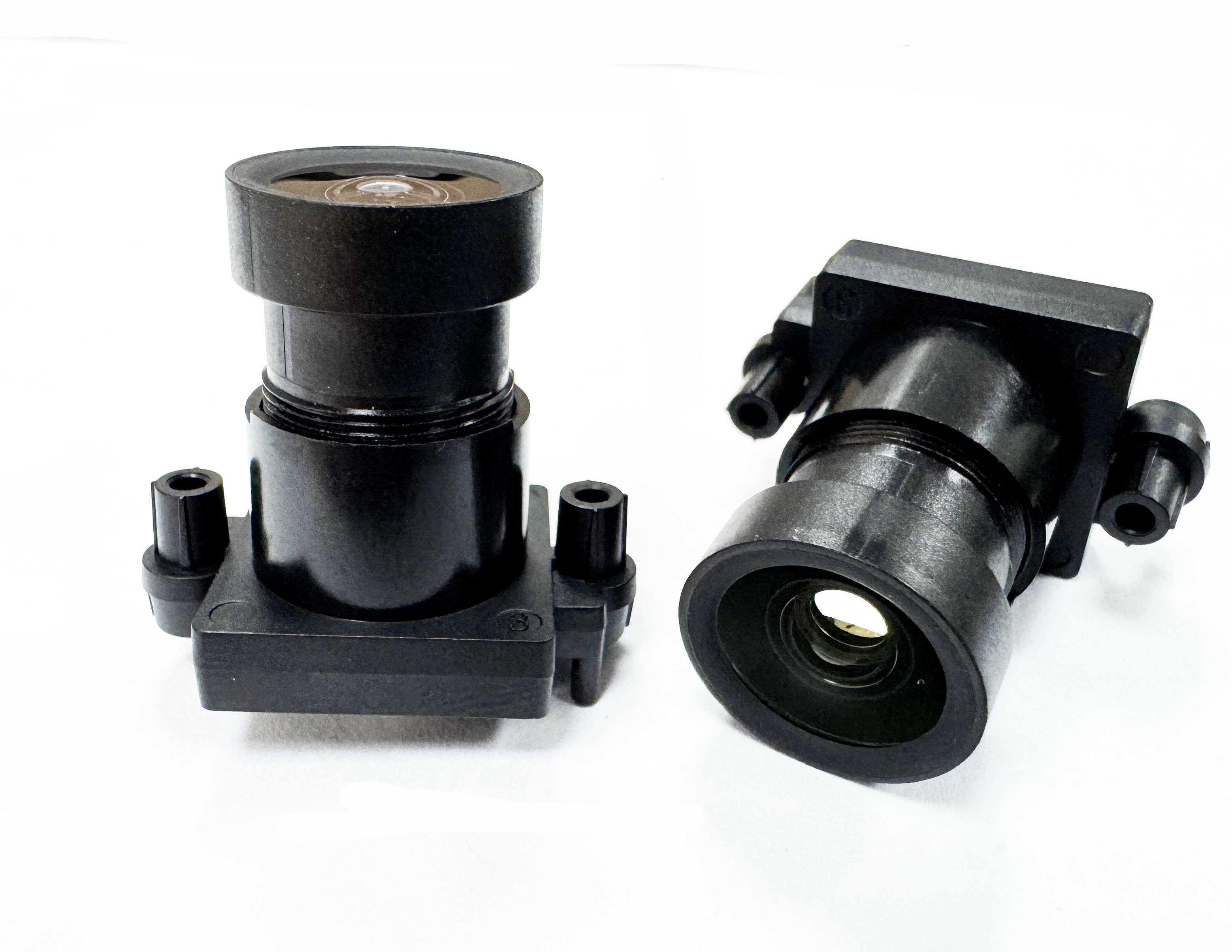
At Shanghai Silk Optical Technology Co., Ltd., we recognized this raw material volatility early. While we manufacture premium all-glass lenses for extreme environments, we heavily advocate for 1G3P (1 Glass, 3 Plastic) or 2G2P hybrid structures for 90% of standard commercial and robotics applications.
How Hybrids Protect Your BOM: By using a hybrid design, we strategically utilize only one or two highly critical HRI glass elements in the optical path. These glass elements handle the heavy lifting: correcting color aberrations and providing absolute thermal stability. We then use ultra-precise, injection-molded optical plastics for the remaining elements to shape the field of view.
This drastically reduces the total volume of expensive, rare-earth-doped glass required per lens. It allows us to deliver strict 5MP resolution and low CRA performance while insulating our clients from the upstream raw material price shocks currently hitting the all-glass market.
The Bottom Line
The era of cheap, infinitely available high-refractive-index glass is facing a reality check in 2026. Procurement teams that secure their supply chains early and embrace smart, hybrid optical engineering will maintain their margins. Those who blindly order traditional all-glass units without watching the rare-earth metals market will likely face unpleasant pricing surprises by October.
(Concerned about how raw material costs will affect your upcoming production runs? Contact the engineering and procurement team at Shanghai Silk Optical to discuss cost-stable hybrid lens solutions for your Q3/Q4 projects.)