
How does M12 fisheye lens transform ultra-wide imaging performance?
Abstract
The M12 fisheye lens is a compact optical solution designed to capture extremely wide fields of view with strong distortion characteristics that are often used creatively or functionally in machine vision, surveillance, robotics, and automotive imaging systems. This article explores how the M12 fisheye lens works, its key advantages, application scenarios, and selection guidelines to help users solve common imaging challenges such as narrow viewing angles, blind spots, and low spatial coverage. It also highlights how BOSHI delivers optimized lens solutions for industrial and commercial imaging systems.
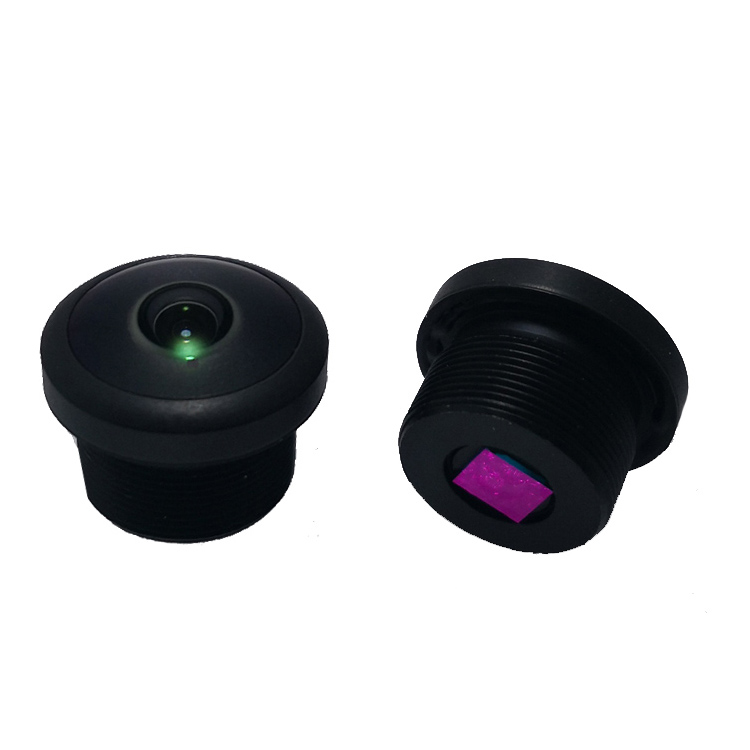
Table of Contents
- Article Outline
- 1. Introduction to M12 Fisheye Lens
- 2. How M12 Fisheye Lens Works
- 3. Key Advantages
- 4. Application Scenarios
- 5. How to Choose the Right M12 Fisheye Lens
- 6. Technical Comparison Table
- 7. FAQ
- 8. Conclusion & Contact
Article Outline
- Definition and structure of M12 fisheye lens
- Optical principles behind fisheye distortion
- Benefits in industrial and commercial systems
- Real-world usage in surveillance, robotics, and automotive vision
- Selection criteria including focal length, sensor compatibility, and distortion level
- Comparison of different fisheye lens parameters
- Common questions and practical answers
1. Introduction to M12 Fisheye Lens
The M12 fisheye lens is a miniature threaded lens type widely used in compact imaging systems. It is characterized by its M12 mount (12mm diameter thread), making it compatible with a broad range of board-level cameras and embedded vision devices.
Unlike standard lenses, fisheye lenses intentionally produce barrel distortion to achieve a field of view that can exceed 180 degrees. This makes them particularly valuable in scenarios where maximum environmental awareness is required.
BOSHI integrates precision engineering into its M12 fisheye lens product line, ensuring stable optical performance even in demanding environments such as industrial automation and smart surveillance.
2. How M12 Fisheye Lens Works
The working principle of an M12 fisheye lens is based on ultra-wide-angle optical projection. Instead of maintaining rectilinear mapping like standard lenses, it compresses spatial information toward the edges of the image circle.
Core optical behavior includes:
- Strong radial distortion to expand field of view
- Short focal length for wide-angle capture
- Multi-element lens structure to reduce chromatic aberration
- Optimized image circle for small sensors
This design enables a single camera to replace multiple narrow-angle cameras in certain applications, reducing system complexity and cost.
3. Key Advantages
The M12 fisheye lens provides several operational advantages that make it a preferred solution in modern imaging systems:
- Ultra-wide field of view: Up to 180° or more coverage
- Compact structure: Ideal for embedded and space-limited devices
- Cost efficiency: Reduces the need for multiple cameras
- Improved situational awareness: Eliminates blind spots
- Flexible integration: Compatible with most M12 mount modules
BOSHI designs its lenses to maintain sharp imaging performance even at extreme edge distortion zones, improving usability in analytical applications.
4. Application Scenarios
The M12 fisheye lens is widely used across multiple industries:
- Security surveillance: Ceiling-mounted panoramic monitoring systems
- Robotics vision: Navigation and obstacle detection
- Automotive systems: Surround-view parking cameras
- Smart home devices: Indoor monitoring with single-camera coverage
- Industrial inspection: Large-area visual scanning
In each of these applications, BOSHI provides tailored optical solutions to ensure compatibility with system-level requirements.
5. How to Choose the Right M12 Fisheye Lens
Selecting the correct M12 fisheye lens requires evaluating multiple optical and mechanical parameters.
- Field of View (FOV): Choose between 150° to 220° depending on coverage needs
- Sensor size compatibility: Match lens with 1/2.7", 1/3", or other sensor formats
- Aperture value: Lower f-number improves low-light performance
- Distortion level: Higher distortion increases coverage but reduces edge accuracy
- Resolution support: Ensure compatibility with HD or 4K sensors
BOSHI recommends selecting lens configurations based on both environmental lighting and system processing capabilities to achieve optimal imaging output.
6. Technical Comparison Table
| Parameter | Standard M12 Lens | M12 Fisheye Lens |
|---|---|---|
| Field of View | 60° - 90° | 150° - 220° |
| Distortion | Low | High (intentional) |
| Use Case | Focused imaging | Panoramic coverage |
| System Complexity | Medium | Low (fewer cameras needed) |
7. FAQ
Q1: Can M12 fisheye lens be used for accurate measurement?
It can be used, but requires software calibration to correct distortion for measurement accuracy.
Q2: Is fisheye distortion always a disadvantage?
No. In surveillance and robotics, distortion is beneficial because it increases field coverage.
Q3: Can BOSHI customize M12 fisheye lenses?
Yes. BOSHI provides customized optical configurations based on sensor type, resolution, and application requirements.
Q4: Does fisheye lens reduce image quality?
Not necessarily. High-quality designs maintain sharpness while optimizing edge performance.
8. Conclusion & Contact
The M12 fisheye lens plays a critical role in modern imaging systems by enabling ultra-wide coverage in compact devices. Its ability to reduce blind spots, simplify system architecture, and enhance situational awareness makes it a valuable component in surveillance, robotics, and automotive applications.
With advanced optical engineering, BOSHI delivers high-performance M12 fisheye lens solutions that meet diverse industrial needs while maintaining consistent image quality and durability.
If you are looking to integrate reliable wide-angle imaging into your system or require customized optical solutions, BOSHI is ready to support your project from design to production.
Contact us today to discuss your M12 fisheye lens requirements and receive professional technical support and tailored solutions from BOSHI.