

How F1.0 Low-Light Lenses Enable Full-Color Night Surveillance
Introduction: Night Surveillance Has Entered a New Era
For many years, infrared illumination has been the standard solution for security cameras working at night.When the environment becomes dark, the camera turns on IR LEDs, switches to black-and-white mode, and continues recording.This technology is reliable and remains widely used today.
However, the security industry is changing.
Modern surveillance systems are no longer only asking:“Can the camera see something?”
They are asking:“Can the camera capture enough information to understand what happened?”
With the growth of:
AI surveillance
Smart cities
Intelligent video analytics
Automated security systems
a simple black-and-white image is sometimes no longer enough.
A security system may need to know:
What color was the vehicle?
What was the person wearing?
Was the object a bag or a package?
Was the vehicle entering or leaving?
In these situations, color and detail are not just image quality improvements.
They are valuable data.
This is why F1.0 large-aperture low-light lenses are becoming an important optical solution for next-generation surveillance systems.
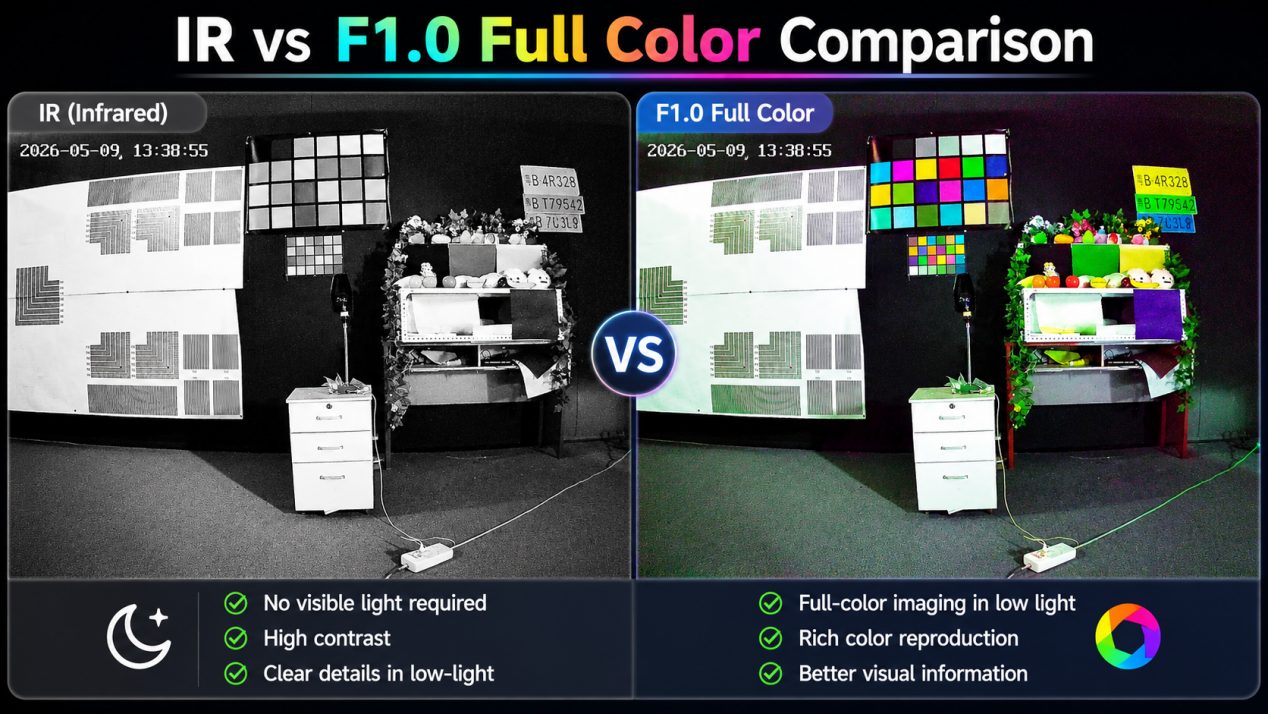
The Problem With Traditional Infrared Night Vision
Before discussing new technology, we should be fair:
Infrared is not a bad solution.
For completely dark environments, IR illumination is still extremely useful.
However, traditional infrared systems also have some limitations.
1. Night Images Usually Lose Color Information
Most infrared cameras provide black-and-white images at night.
For basic monitoring, this works well.
But when a security system needs more details, missing color information becomes a problem.
For example:
A black-and-white image may tell you that a vehicle arrived.
A full-color image may tell you:
The vehicle color
Possible brand differences
Surrounding environmental details
For human operators and AI systems, these extra details can make a significant difference.
2. Strong IR Reflection Can Affect Image Quality
Infrared light does not behave exactly like visible light.
Certain surfaces can strongly reflect IR signals:
License plates
Glass
Metal surfaces
Wet roads
Light-colored objects
This may cause overexposure or loss of details in important areas.
The camera can see the scene, but sometimes the most important information becomes unclear.
3. AI Needs Better Image Information
Many people believe:
“The AI algorithm is powerful enough, so image quality is less important.”
In reality, AI still depends on the original image.
A better algorithm cannot fully recover:
Missing colors
Blurred edges
Lost details
Poor contrast
The quality of AI analysis starts before the algorithm.
It starts with the optical system.
Why F1.0 Low-Light Lenses Are Gaining Attention
The basic idea behind an F1.0 lens is simple:
Collect more light.
The aperture determines how much light can enter the lens. A larger aperture allows more available light to reach the sensor.
Compared with traditional smaller-aperture security lenses, an F1.0 lens can provide significant advantages in low-light environments.
More light means the camera may achieve:
Better brightness
Lower image noise
Faster exposure
Better color retention
Improved moving-object clarity
The key point is:
A good low-light lens does not simply make the image brighter.
It helps preserve more useful information.
But F1.0 Is Not Just About a Bigger Aperture
Some customers see “F1.0” and immediately think:
“Then it must be the best lens.”
Not necessarily.
A large aperture creates higher optical challenges.
When the aperture becomes larger, lens designers need to carefully control:
Sharpness
Distortion
Color difference
Edge performance
Light uniformity
A poor F1.0 lens can produce a bright but unclear image.
For security applications, brightness alone is not enough.
The goal is a balanced image:
Clear details
Natural colors
Stable performance
Reliable mass production
This is where optical design experience becomes important.
Full-Color Night Surveillance: More Than Just Better Pictures
A common misunderstanding is that full-color night imaging is only about making surveillance videos look nicer.
Actually, it provides practical value.
Better Human Identification
Color information helps distinguish:
Different clothing
Personal belongings
Activity details
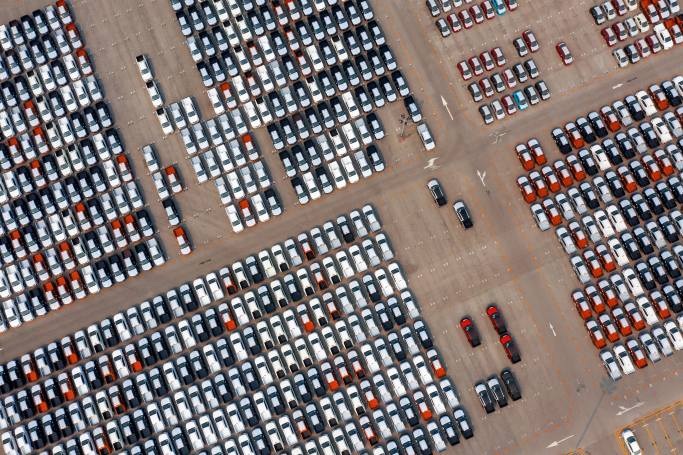
Better Vehicle Recognition
Color can become an important feature for:
Parking management
Traffic monitoring
Security investigation
Better AI Analysis
AI systems can use additional visual information for:
Object classification
Behavior analysis
Tracking
In other words:
Better optics create better data.
Better data helps create smarter systems.
Where F1.0 Low-Light Lenses Are Suitable
F1.0 low-light security lenses are especially valuable in environments where some visible light is available.
Typical applications include:
Parking Lots
Parking areas usually have:
Street lights
Vehicle headlights
Building lights
A large-aperture lens can use these available light sources to maintain color and details.
Residential Security
For communities and apartment entrances, full-color night images can help identify visitors and vehicles more clearly.
Commercial Buildings
Entrances, corridors, and outdoor areas often have uneven lighting conditions.
A low-light lens can improve image consistency.
Smart City Applications
Urban environments are rarely completely dark.
Street lighting and surrounding illumination provide opportunities for full-color night imaging.
Choosing the Right Low-Light Security Lens
When selecting a low-light lens, customers should not only look at the aperture.
A complete evaluation should include:
Sensor Compatibility
The lens must match the sensor size and optical requirements.
Resolution Performance
The lens should maintain sufficient detail across the image, not only in the center.
Field of View
The lens angle should match the monitoring scene.
Mechanical Compatibility
Mount design, size, and installation requirements are also important.
Real Testing
Actual image comparison is always more valuable than specification numbers alone.
A professional lens manufacturer should help customers evaluate the entire camera system, not simply recommend a product.
Boshi Optics: Optical Solutions for Smarter Night Surveillance
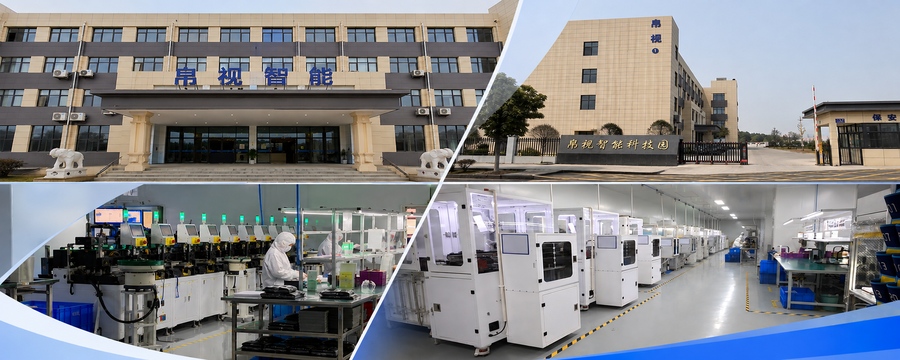
At Boshi Optics, we believe that better surveillance starts with better optical input.
Our low-light security lens solutions are designed for modern camera systems requiring improved night imaging performance.
One example is a compact M12 security lens solution featuring:
4mm focal length
F1.0 large aperture
Support for 2–5MP camera systems
Compatibility with 1/2.7-inch sensors
Wide application range for security monitoring
The purpose of this type of optical design is simple:
Help cameras capture more useful information when lighting conditions become challenging.
From security cameras and smart city systems to AI vision applications, Boshi Optics works with customers to develop optical solutions that match real-world requirements.
Conclusion: The Future of Night Surveillance Is About Information, Not Just Visibility
Infrared technology solved the first challenge of night surveillance:
Making cameras see in darkness.
But modern intelligent systems need a higher level of performance.
They need:
More details
More colors
More reliable information
F1.0 low-light lens technology represents a shift from simply “seeing at night” to “understanding the night.”
Because in the era of AI surveillance:
The camera is no longer just recording.
It is providing the information that intelligent systems use to make decisions.
And every smart decision begins with better optics.