
How to Choose a Low-Light FPV Lens: F1.0 vs IR
During the early hardware scouting phase for next-generation industrial drones, defense UAVs, or high-speed FPV (First-Person View) systems, I get hit with the same question at least three times a week: "Should we source an F1.0 large-aperture lens for a 'Blacklight' full-color system, or stick to a traditional Infrared (IR) illumination setup?"
To be completely blunt, whenever someone frames this as a simple, binary choice, I can't help but sigh.
As an optical engineer at Shanghai Silk Optical, my day-to-day reality consists of fighting refractive indices, scraping for fractions of a percent on MTF curves, and balancing the harsh laws of physics against tight production budgets. I see far too many product lines fail during high-velocity field testing because a procurement team swallowed a generic sales pitch hook, line, and sinker.
"F1.0 is the future," they tell you. Or "IR is cheap and indestructible."
Don't buy into the hype. Optical design is an unyielding game of physical trade-offs. Let’s look past the marketing PPTs and break down what actually happens to your FPV imaging pipeline when you choose one over the other.
1. F1.0 "Blacklight" Full Color: The Photon Monster (And Its Hidden Tax)
The entire premise of active low-light, full-color technology hinges on the F1.0 aperture. If you aren't an optics geek, here is the quick math: the F-number is the ratio of the lens's focal length to its entrance pupil diameter. Every time you drop an F-stop, you double the light reaching the sensor. Moving from a standard F2.0 lens to an F1.0 means you are dumping four times more light onto your CMOS pixels.
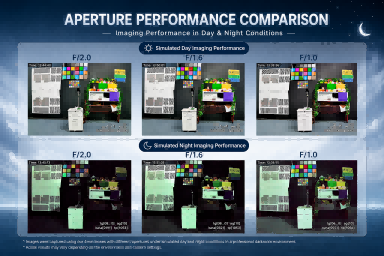
In real-world FPV deployment—say, an autonomous inspection drone navigating a dimly lit warehouse or a nighttime search-and-rescue UAV—this means you don't need intrusive, power-hungry, blinding white LED glare to capture high-contrast video. For onboard AI models that depend on chromatic data to classify objects (like identifying the color of a hazardous pipe valve or a target's clothing), F1.0 is spectacular.
But here is the catch that amateur suppliers won't tell you: wide-open apertures introduce absolute chaos to optical aberrations. When you open the iris to F1.0, light rays strike the outer edges of the lens elements at incredibly steep angles. This triggers two massive problems for FPV:
-
Razor-Thin Depth of Field (DoF): Your margin for error drops to millimeters. If your mechanical lens housing flexes even slightly due to internal motor heat or ambient temperature changes, your target drifts completely out of focus.
-
Peripheral MTF Collapse: Spherical aberration and coma will turn the corners of your high-resolution image into a muddy, unusable soup. If your lens can’t maintain a high MTF (Modulation Transfer Function) at the edges, your expensive 4MP or 5MP sensor is effectively behaving like a 1.3MP sensor.
To counteract this, we can't just use cheap, off-the-shelf spherical glass. We have to design around ASP (Aspherical Lens) elements to force those rogue edge-rays back into a single focal point.
Actually, let me rephrase that—it’s not just about using aspherical shapes; it's about the material choice. If you buy a cheap, all-plastic F1.0 lens for a drone, it will fail the moment ambient temperatures fluctuate or the flight electronics heat up.
This is exactly why we built our flagship PL100 Blacklight Lens. It is a hard-boiled F1.0, 4mm, 4MP/5MP-ready optical monster built explicitly around an advanced 7E structure (an all-glass/hybrid architecture). By utilizing premium glass elements housed in custom thermal-resistant barrels, the PL100 achieves active thermal compensation. Whether your FPV platform is fighting freezing high-altitude winds or soaking up heat from high-wattage transmission boards (-20°C to +70°C), the focus plane stays perfectly locked.
2. Infrared (IR) Night Vision: The Cost-Effective Workhorse (With a Wavelength Trap)
On the other side of the fence, we have traditional IR illumination (typically paired with 850nm or 940nm active IR LEDs). Lenses in this category—like our volume-optimized PL071 6G All-Glass series—are incredibly mature, highly stable, and exceptionally friendly to your procurement budget.
The main advantage of an IR system is uncompromising, stark contrast. In absolute zero-lux environments—such as unlit subterranean tunnels or deep forest perimeters where there is zero ambient light—IR turns the world into a sharp, high-contrast black-and-white map. It strips out color confusion, giving edge AI algorithms and SLAM (Simultaneous Localization and Mapping) visual navigation systems crisp boundaries to trace.
However, there's a silent killer waiting in IR setups: Focus Shift.
Here is a common, deeply frustrating scenario for R&D teams: Your engineers calibrate the drone's vision system in the lab during the day. It looks incredibly sharp. Night falls, the drone takes off, the active IR illuminators kick on, and suddenly the live feed looks like someone smeared grease over the lens.
Don't blame the sensor's noise reduction algorithms. It’s fundamental physics. Visible light (400–700nm) and Infrared light (850nm/940nm) travel at different speeds through the same glass medium because the refractive index shifts based on wavelength. If your lens elements aren't deliberately optimized for IR Co-focus, the focal plane for visible light and the focal plane for IR light will land on two completely different depths behind the lens.
To bypass this nightmarish lag, we integrate ED (Extra-low Dispersion) Glass elements and apply specialized broadband coatings so that both wavelengths focus on the exact same micron-level plane on the sensor. Furthermore, if you are flying at high speeds toward a highly reflective surface (like a metal sign or a white building), IR setups are notorious for localized overexposure ("white-out"). Without integrated Blue Glass or specialized filtering to suppress ghosting and secondary reflections, your navigation AI will experience severe latency or outright hallucinations.
3. The FPV Sourcing Decision Matrix: Which Fits Your Drone?
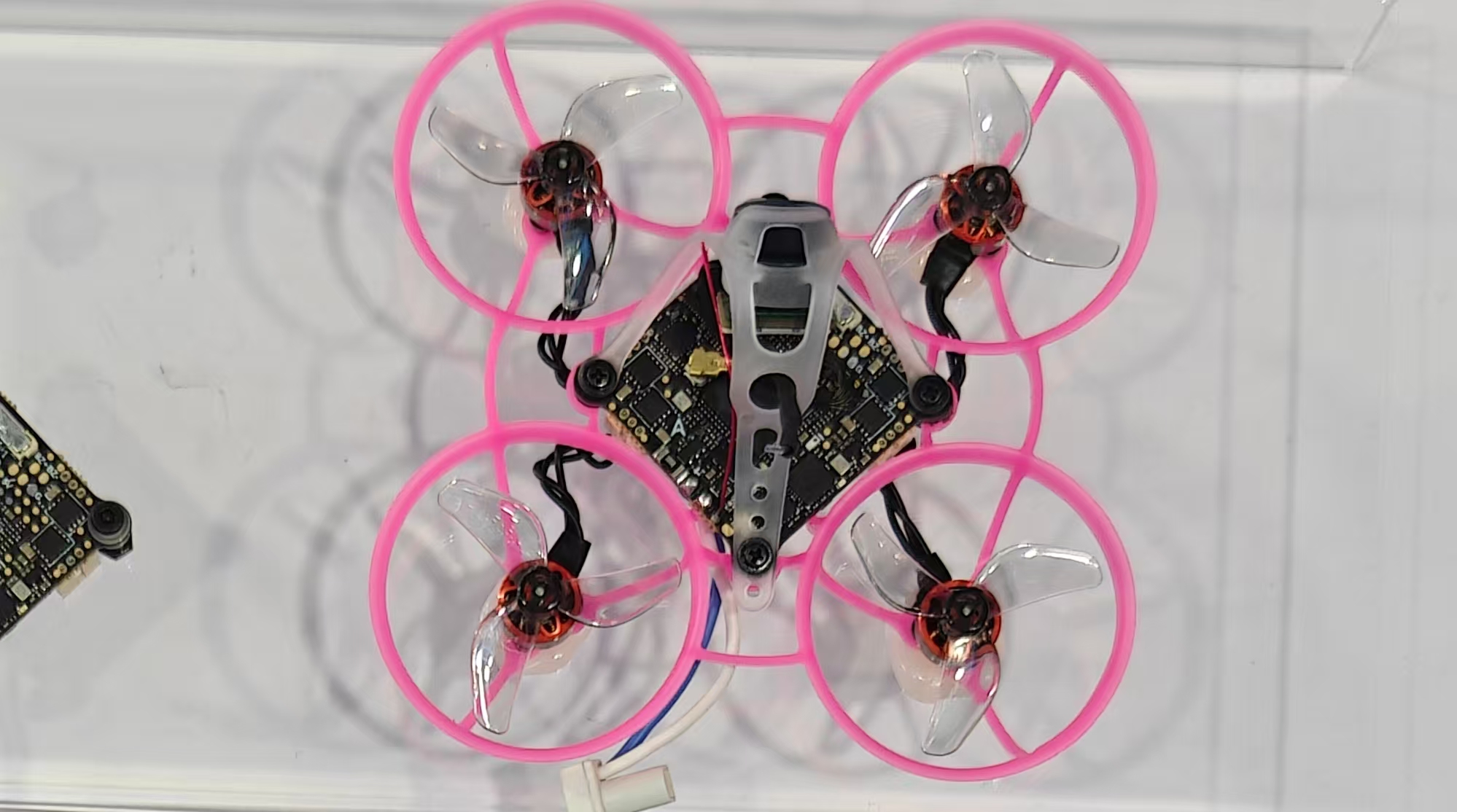
Let’s skip the corporate fluff and lay down a concrete engineering checklist for your next hardware audit:
Sourced the PL100 F1.0 Blacklight Lens if:
-
Color Data is Non-Negotiable: Your drone needs to identify specific wire colors, hazard markers, structural rust, or search-and-rescue target outfits under starlight.
-
Active Emission is a Liability: You are building stealth surveillance platforms, tactical UAVs, or wildlife monitoring drones where bright infrared beams or white spotlights are unacceptable.
-
High-Speed Edge AI Processing: Your onboard computer can't afford to waste GPU/NPU cycles running software sharpening or de-noising filters on a muddy low-light feed. You need high-fidelity "clean" photons straight from a wide-open aperture.
-
Our Recommendation: The PL100 (F1.0, 4mm, M12). Every single unit undergoes rigorous automated Active Alignment (AA Testing) at our production park to ensure that tilt and Chief Ray Angle (CRA) perfectly align with high-end 4MP/5MP sensors before leaving the factory line.
Stick to an IR-Optimized Lens (like the PL071) if:
-
Absolute Zero-Lux Operations: Your FPV drone operates in unlit mines, abandoned buildings, or deep underground infrastructure where there are literally zero ambient photons to amplify.
-
Strict Procurement Budget Constraints: The project is a massive, cost-sensitive fleet deployment of warehouse AGVs or basic perimeter drones that only require basic geometric boundary detection and obstacle avoidance.
-
Pure Geometric SLAM / Mapping: Your localization algorithms only care about high-contrast edge detection and spatial features, making color information irrelevant.
Final Thoughts from the Lab
In precision optics, you don't get something for nothing. If you want the massive low-light payload of an F1.0 lens, you must invest in structural temperature compensation and aspherical glass profiles to stop thermal drift and corner blur. If you choose the cost-efficient route of IR, you must ensure your supplier delivers true IR Co-focusing to prevent nighttime blindness.
At Shanghai Silk Optical, we manufacture over 6 million lenses a month. We don't deal in generic sales pitches; we deal in MTF curves and physical reliability. If you are tired of guessing your optical tolerances and want to talk real hardware specifications for your next drone, security, or medical vision array, reach out. Let’s build something that actually works when the lights go out.
Previous:How Does a Camera Lens Work?