

How to Choose the Perfect M12 Lens for a 1/2.7" Sensor: Dodging the "Vignetting" and "Soft Edge" Traps
Trap 1: The "Tunnel Vision" Effect (Vignetting)
To understand vignetting, imagine trying to fit a large square peg into a small round hole.
Every lens projects a circular image onto the rectangular camera sensor. This is called the Image Circle. A 1/2.7-inch sensor has a specific physical diagonal dimension (roughly 6.6mm).
-
If the lens image circle is smaller than the sensor: The corners of the rectangular sensor won't receive any light. The result? Hard black corners on your footage.
-
If the lens image circle is exactly the right size or slightly larger: The entire sensor is bathed in light. You get a clean, full-frame image.
The Fix: When buying an M12 lens, you cannot just look at the focal length (like 4mm). You must check the Target Sensor Size specification. If you put a lens designed for a smaller 1/3" or 1/4" sensor onto your 1/2.7" sensor, you will get vignetting every single time. Always ensure the lens specification explicitly states compatibility with 1/2.7" formats.
Trap 2: The "Sharp Center, Blurry Edges" Mystery
Okay, so you bought a lens with the correct image circle. The dark corners are gone. But now you have a new problem: the license plate in the center of the frame is crystal clear, but the trees at the edge of the frame look completely out of focus.
This happens for two main reasons:
1. A Mismatch in Chief Ray Angle (CRA) Think of the pixels on a modern sensor as tiny, deep buckets. If light drops straight down into the bucket (in the center of the sensor), it’s captured perfectly. But at the edges of the sensor, light comes in at an angle. If that angle is too steep, the light hits the wall of the "bucket" and bounces away, causing blurry edges and color shifts. A high-quality M12 lens is engineered to bend those edge-rays so they drop cleanly into the sensor's pixels. For example, precision lenses keep the CRA under 15° to ensure uniform brightness and sharpness across the entire field of view.
2. Poor Lens Structure and Curvature of Field Cheap lenses often suffer from "curvature of field." Because lens elements are curved, the focal plane they project is actually curved like a bowl, not flat like your sensor. If the center is in focus, the edges are out of focus. Correcting this requires multiple, precisely shaped lens elements.
The Solution: Precision Optics Built for the Task
You don't have to compromise by cropping your image or accepting blurry corners. At Shanghai Silk Optical Technology Co., Ltd., we design our M12 lenses to seamlessly marry with modern sensors.
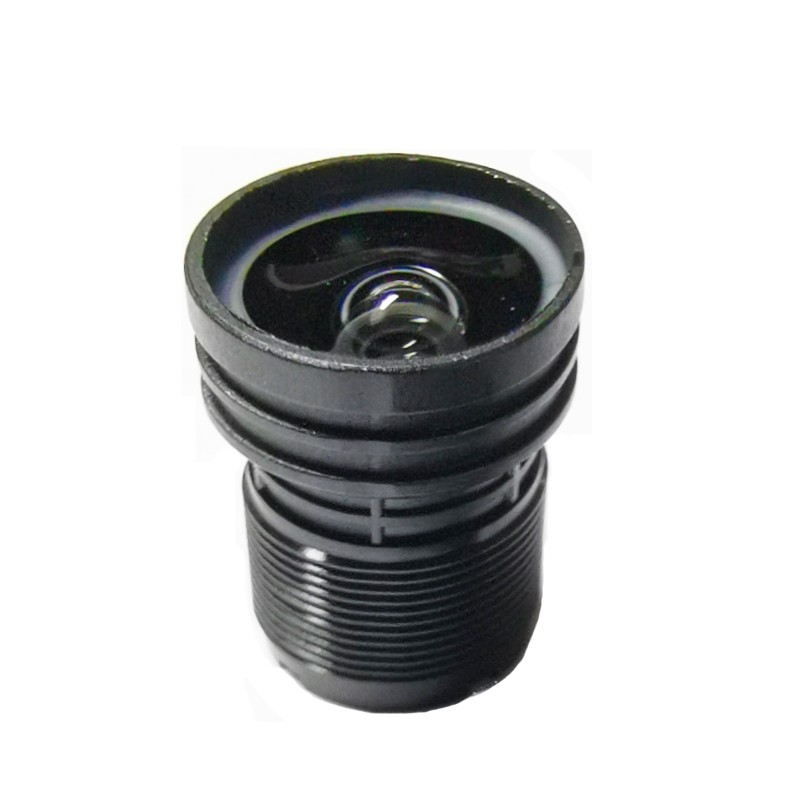
Take our PL100 Series M12 Lens as an example of doing it right:
-
Perfect Fit for 1/2.7": Engineered with an image circle that perfectly covers 1/2.7" sensors, completely eliminating dark corners.
-
Optimized CRA (<15°): The light hits the edges of your sensor at the perfect angle, ensuring edge-to-edge brightness.
-
7E All-Glass Structure: By using seven specialized glass elements, we flatten the focal plane and correct optical distortion (keeping TV distortion down to a remarkable -12%). This means the corners are just as sharp and high-resolution (2MP-5MP) as the dead center.
The Bottom Line
Line
Your 1/2.7" sensor is only as good as the light that hits it. Don't bottleneck your expensive electronics with a mismatched piece of glass. By verifying the image circle and paying attention to edge-to-edge optical corrections, you can guarantee a crisp, clear, and professional image for your clients.
(Looking for the perfect M12 match for your camera project? Contact our technical team today to request samples and detailed specifications.)