

Why Aspherical Optics Are Everywhere in Modern Cameras
If you take apart a modern camera lens, there is a good chance you will find something that looks slightly different from the other optical elements.
It may be thicker in the center.
It may have an unusual curvature.
And unlike a conventional spherical lens surface, its curvature does not follow a simple sphere.
This is an aspherical lens element.
Aspherical optics are now found in everything from smartphone cameras and compact security cameras to automotive imaging systems, drones, machine vision cameras, and professional photographic lenses.
That wasn't always the case.
So what changed?
The short answer is that modern cameras are asking lenses to do much more while becoming smaller.
And physics, unfortunately, has not agreed to make that easy.
A Spherical Lens Is Actually a Convenient Compromise
Let's start with the traditional approach.
A spherical lens surface is based on a sphere.
That makes the surface relatively straightforward to manufacture.
But there is a problem.
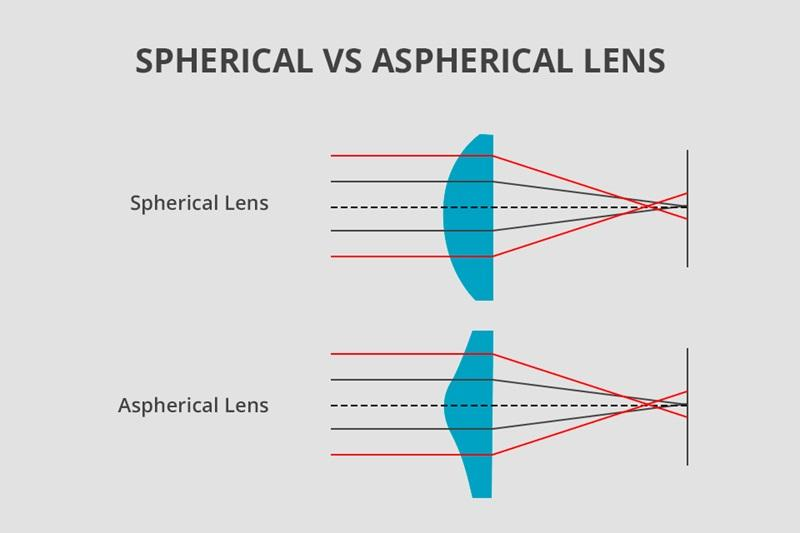
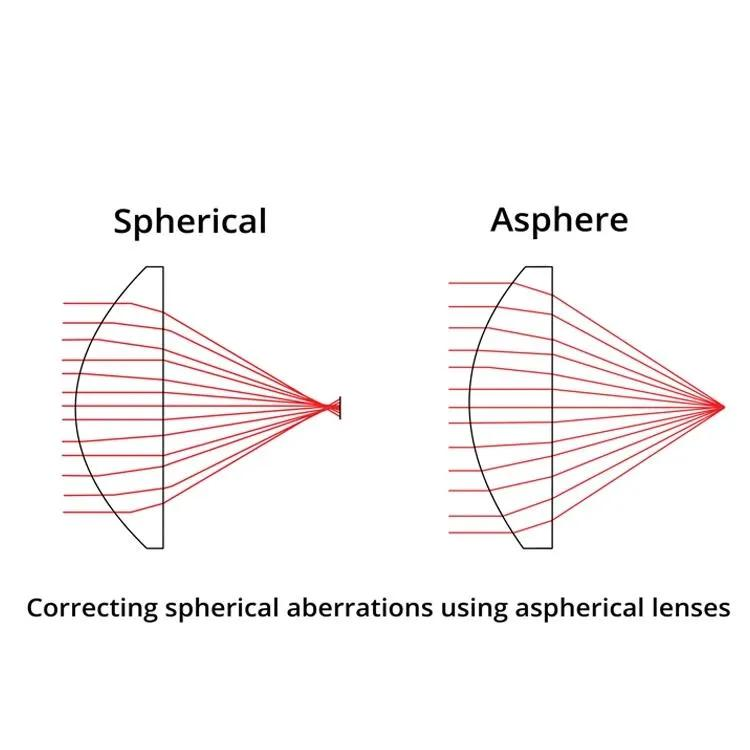
Light rays passing through different parts of a spherical lens do not always converge at exactly the same point.
Rays near the optical axis and rays passing through the outer portion of the lens can focus differently.
This produces spherical aberration.
The image becomes less sharp, particularly when the lens is used at a large aperture.
You could add more optical elements to compensate for the problem.
And historically, that is exactly what lens designers did.
But now you have another problem:
More elements mean more space, more weight, more surfaces, more manufacturing complexity, and potentially more cost.
Eventually someone asks the obvious question:
Why not change the shape of the lens surface itself?
That's where aspherical optics become useful.
What Makes an Aspherical Surface Different?
A spherical surface has a constant radius of curvature.
An aspherical surface does not.
Its curvature changes gradually from the center toward the edge.
That may sound like a small geometric difference.
Optically, it is extremely useful.
By carefully controlling the surface shape, designers can make light rays converge in a much more controlled way.
This allows an aspherical element to correct optical aberrations that would otherwise require several conventional spherical elements.
In simple terms:
Instead of adding more glass to fix a problem, sometimes you can change the shape of the glass.
That is one of the major reasons aspherical optics became so important.
The Real Advantage Is Not Just “Sharper”
People often describe aspherical lenses as a way to improve sharpness.
That's true, but incomplete.
The bigger advantage is optical design freedom.
An aspherical surface can help engineers manage several optical characteristics, depending on the design.
These may include:
Spherical aberration
Coma
Astigmatism
Distortion
Field performance
Overall lens size
This matters enormously in compact cameras.
Modern camera modules often need to fit inside very tight mechanical spaces while still providing:
Wide fields of view
Large apertures
High resolution
Good edge performance
Trying to achieve all of this using only conventional spherical elements can become extremely difficult.
Aspherical optics give the designer another tool.
And sometimes, one well-designed aspherical surface can do the work that several conventional surfaces would otherwise need to perform.
Why Wide-Angle Cameras Love Aspherical Optics
Wide-angle lenses are particularly challenging.
As the field of view becomes larger, light enters the optical system from increasingly different angles.
Keeping those rays under control becomes harder.
Distortion becomes more difficult to manage.
Edge performance becomes more difficult to maintain.
This is one reason aspherical elements appear so frequently in wide-angle camera designs.
Consider a compact security camera.
The manufacturer may want a wide field of view, small lens dimensions, high resolution, and good low-light performance.
Those requirements pull the optical design in different directions.
A wider aperture helps collect light.
A wider field of view increases coverage.
A smaller package helps product integration.
But every one of those decisions creates optical challenges.
Aspherical surfaces can help designers find a workable balance.
Why Smartphones Made Aspherical Optics Even More Important
Smartphones are probably the easiest example to understand.
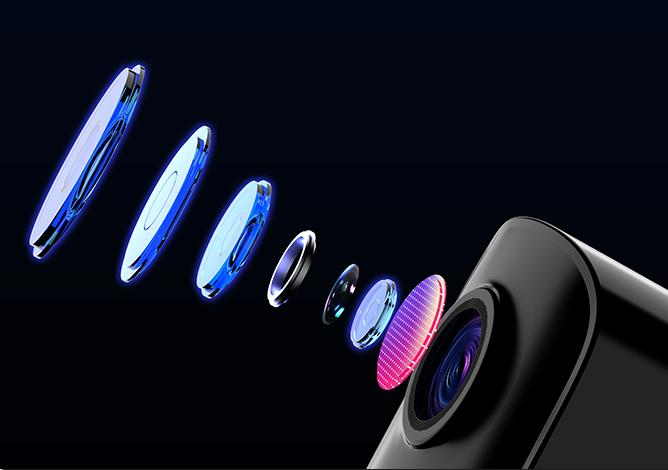
A smartphone camera is tiny.
Yet manufacturers expect it to produce images that would have seemed remarkable from a much larger camera twenty years ago.
There is simply not enough physical space to solve every optical problem by adding large numbers of conventional glass elements.
The solution is highly optimized optical design.
Aspherical surfaces can provide substantial correction within a very compact package.
The same principle applies to other miniature imaging systems.
Security cameras, embedded vision modules, automotive cameras, drones, robots, and smart devices all face similar pressure:
More optical performance in less physical space.
But Aspherical Does Not Mean “Automatically Better”
This is an important point.
An aspherical lens element is not automatically superior to a spherical one.
It is a design tool.
A poorly designed aspherical surface can still produce poor optical performance.
And using an aspherical element does not eliminate the need to manage:
Chromatic aberration
Distortion
Manufacturing tolerances
Alignment
Coating performance
Thermal behavior
The entire optical system still has to work together.
In fact, aspherical surfaces can sometimes make manufacturing and quality control more demanding because the surface geometry is more complex.
So the real achievement isn't simply:
“We used an aspherical lens.”
It is:
“We used the right optical geometry to solve the right problem.”
Manufacturing Is Where the Theory Gets Interesting
There is a big difference between designing an aspherical surface on a computer and manufacturing thousands of them consistently.
The required surface profile needs to be produced accurately.
The element must then be assembled correctly.
Even a good optical design can lose performance if manufacturing tolerances are poorly controlled.
This is why optical manufacturers such as Boshi Optics need to consider design and manufacturing together.
Modern optical production can involve precision molding, optical component processing, assembly, dimensional inspection, and optical performance testing.
The more demanding the optical surface, the more important process control becomes.
The Bigger Reason Aspherical Optics Are Everywhere
So why do we see aspherical optics in so many modern cameras?
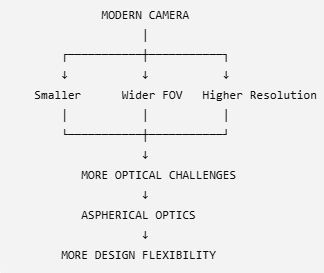
Because cameras have evolved.
They are smaller.
Sensors are more capable.
Fields of view are wider.
Apertures are larger.
Resolution requirements are higher.
And cameras are being placed in increasingly constrained environments.
A drone cannot carry a huge lens.
A robot needs compact vision modules.
A vehicle needs cameras that fit into carefully designed housings.
A smartphone has almost no room to spare.
Aspherical optics give optical engineers another degree of freedom to solve these problems.
They are not a magic ingredient.
They are simply one of the most useful tools modern optical designers have.
And considering how much we now ask from such tiny cameras, we should probably be grateful for them.