

Why Do Camera Lenses Need to Survive Temperature Changes
Put a camera outside in winter.
Then leave it there until summer.
The camera may still turn on. The sensor still works. The electronics are still running.
But does the image look exactly the same?
Not necessarily.
This is one of those things that is easy to overlook when choosing a camera lens. A lens can look perfectly sharp in a laboratory at room temperature, yet behave differently after spending hours in a hot parking lot or a freezing outdoor environment.
The reason is simple:
A camera lens is not dimensionally or optically stable when temperature changes.
And when you are dealing with an optical system measured in fractions of a millimeter, “small” changes can become very real image problems.

A Lens Is a Mechanical System as Much as an Optical One
When people look at a camera lens, they usually think about glass.
That makes sense. The glass is where the light goes.
But inside a real lens, there is much more going on.
There are optical elements, lens barrels, spacers, holders, threads, adhesive materials, and sometimes plastic optical elements. Different parts are made from different materials, and different materials respond differently to temperature.
When temperature rises, materials expand.
When temperature falls, they contract.
The problem is that they do not all expand or contract by exactly the same amount.
Imagine several optical elements positioned at carefully calculated distances from each other.
Now heat the entire lens.
The lens barrel expands. The optical elements change slightly. The spacing between elements changes. The refractive properties of the optical materials can also change with temperature.
The lens has not broken.
Nothing looks obviously wrong from the outside.
But optically, the system is no longer exactly where the designer originally intended it to be.
That is where things start getting interesting.

The Focus Can Move Without the Camera Moving
One of the most common consequences is focus shift.
A fixed-focus lens is designed so that the image formed by the optical system falls in the right place relative to the sensor.
Change the optical geometry, and the best-focus position can move.
This is particularly important for cameras that are permanently installed.
Imagine a security camera focused during assembly at around 23°C.
At night, the temperature drops to -20°C.
During the following afternoon, the camera housing sits under direct sunlight and becomes much hotter.
The camera itself hasn't moved.
The sensor hasn't moved.
But the lens may have changed enough for the point of best focus to shift.
At the factory, the image looked sharp.
Outside, several hours later, it may look noticeably softer.
This is why “the lens works at -20°C to 60°C” and “the lens maintains good optical performance from -20°C to 60°C” are not necessarily the same statement.
The second question is the one engineers actually care about.
Why Optical Materials Matter
Temperature does not only change the physical dimensions of a lens.
Optical materials also have temperature-dependent refractive properties.
This means the optical behavior of a lens can change in two ways at the same time:
the geometry changes, and the optical material itself changes.
For a simple optical system, the effect may be relatively small.
For a more demanding lens, especially one with multiple elements and tight performance requirements, these changes can accumulate.
The result may show up as focus shift, changes in MTF, altered aberration behavior, or other changes in image quality.
This is also why lens design is never just about calculating the optical path at one temperature.
A good design needs to consider the environment in which the lens will actually operate.
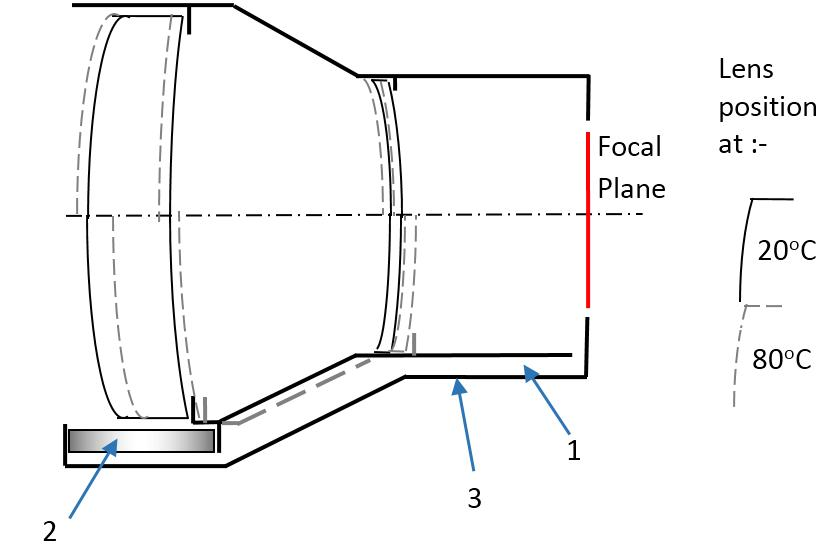
This Is Why Athermalization Exists
This brings us to a term optical engineers use frequently:
athermalization.
It sounds complicated, but the basic idea is quite practical.
If temperature is going to change the lens anyway, why not design the optical system so that those changes compensate for each other?
Engineers can select optical materials with different thermal characteristics, adjust element spacing, choose suitable mechanical materials, or design the mechanical structure to compensate for thermal expansion.
The goal is not necessarily to make every individual component immune to temperature.
That would be unrealistic.
The goal is to make the optical system as a whole less sensitive to temperature changes.
This becomes increasingly important in automotive cameras, outdoor surveillance, industrial vision, drones, and other applications where the camera cannot live in a comfortable indoor room.
Outdoor Cameras Have a Much Harder Life
Consider a parking-lot security camera.
At night, the camera may operate in a cold environment.
During the day, the same camera may sit inside a dark housing exposed to direct sunlight. The temperature inside the housing can be significantly different from the surrounding air.
Now imagine doing this every day.
The issue is not simply whether the lens can survive one hot day or one cold night.
It is whether the optical system can maintain its performance through repeated temperature changes.
That is why temperature cycling is useful during product evaluation.
Engineers can expose the lens or camera system to different temperature conditions and then check whether optical performance remains within the required range.
For a lens manufacturer, this kind of testing is much more informative than simply checking whether the lens still turns on afterward.
A camera that powers up is not necessarily a camera that still produces a good image.
Automotive Cameras Push the Problem Further
Automotive applications make thermal stability even more important.
A vehicle can move from a cold outdoor environment into direct sunlight. The camera may be mounted behind a windshield, near the vehicle body, or in another location where local temperatures become quite high.
The camera also needs to work repeatedly through these temperature cycles over its service life.
For this reason, automotive lens development often pays close attention to thermal behavior, mechanical stability, optical alignment, and long-term consistency.
The same principle applies to other demanding imaging applications.
A drone flying at altitude does not experience the same thermal environment as a camera sitting on a desk.
An industrial camera near machinery may experience continuous heat.
An outdoor surveillance camera may face large day-night temperature differences.
The optical design has to match the actual environment—not the comfortable conditions of the laboratory.

Temperature Testing Is Where the Difference Shows Up
This is also where the difference between a lens sample and a production-ready lens becomes apparent.
During development, an optical design may perform very well at room temperature.
But once the lens enters mass production, another question appears:
Can the same optical performance be maintained across production batches and across temperature conditions?
That requires more than optical calculation.
It involves material selection, mechanical tolerances, assembly accuracy, inspection, and environmental testing.
Boshi Optics approaches lens manufacturing as an integrated process, covering optical processing, precision molding, lens assembly, and inspection. For applications with demanding environmental requirements, this manufacturing consistency becomes just as important as the original optical design.
Because there is little value in designing a lens that performs beautifully at 23°C if the real application spends most of its life somewhere else.
So, Does Every Lens Need Extreme Temperature Resistance?
No.
And this is an important point.
A lens for an indoor camera does not necessarily need the same thermal requirements as an automotive camera or an outdoor security system.
There is no universal “best” operating temperature range.
The right specification depends on the application.
What matters is understanding the actual environment before choosing the lens.
Where will the camera be installed?
What is the expected temperature range?
Will the temperature change slowly or rapidly?
Will the lens experience repeated temperature cycling?
Does the application require stable focus across the entire range?
These questions are often more useful than simply asking for the highest temperature rating on a datasheet.
A Lens Has to Work Where the Camera Works
This is the part that is sometimes missed.
A camera lens is not tested so that a manufacturer can put an impressive temperature number on a specification sheet.
Temperature performance matters because the image matters.
A lens that stays mechanically intact but loses focus, contrast, or optical consistency under real operating conditions has not really solved the problem.
For optical engineers, procurement teams, and camera manufacturers, the better question is therefore not:
“Can this lens survive the temperature?”
It is:
“Can this lens maintain the optical performance our camera needs throughout the temperature range?”
That is a much more useful question.
Because cameras do not live in laboratories.
They live on cars, buildings, drones, machines, streets, factories—and increasingly, in places where the temperature is anything but comfortable.
A good camera lens is not designed for one temperature. It is designed for the environment in which the camera actually has to work.