

Choosing a Camera Lens for Robotics: What Matters Beyond Field of View
A mobile robot can have excellent motors, reliable navigation software, and a powerful processor—and still make poor decisions if its camera does not capture the right visual information.
For an autonomous guided vehicle (AGV), warehouse robot, inspection robot, or service robot, the camera lens is not simply a small part attached to the sensor. It determines how much of the environment enters the image, how objects are represented, and how consistently the vision system can interpret what it sees.
Choosing a lens for robotics therefore starts with the task the camera must perform. A lens designed for broad obstacle awareness may not be ideal for reading a small label, inspecting a connector, or measuring a component. The right choice depends on the robot’s movement, camera placement, sensor, lighting, and the information the vision algorithm needs.
1. Define the vision task before choosing the lens
“Robot vision” covers many different jobs. Navigation and obstacle detection often need a broad view of the surrounding area. Pick-and-place systems may need to locate an object precisely. Inspection robots may need to reveal small defects or surface details. A delivery robot may need to recognize people, doorways, signs, and floor boundaries.
Write down what the camera must detect or measure. Then identify where that information appears in the image and how much detail is required. If the algorithm only needs to detect whether an obstacle is present, the lens requirements may differ from a system that must estimate an object's dimensions or read a code.
This step also helps avoid paying for optical performance that the application does not use. A very wide field of view may help navigation, but it can reduce the number of pixels available to represent a distant object. A narrower view can provide more detail in a target region but may leave less of the environment visible.
Start with the required result, not a favorite focal length.
2. Match the lens to the sensor—not only its megapixel rating
Sensor resolution is important, but it is not enough to establish lens compatibility. The sensor’s active dimensions, pixel size, spectral response, and optical requirements can all affect the result.
The lens image circle must cover the sensor area. If it does not, the image may show darkened corners or unusable areas. Optical performance must also be evaluated across the portion of the sensor that matters to the application. A system may appear sharp in the center but lack enough contrast near the edges for reliable recognition.
When asking a lens supplier for a recommendation, provide the sensor manufacturer and model whenever possible. A sensor datasheet is even better. It gives the optical team a more reliable starting point than “we need an 8 MP lens.”
The complete camera system—including sensor, lens, focus position, and image processing—determines the final result. A megapixel label is a useful filter for shortlisting candidates, not a guarantee of system performance.
3. Calculate field of view at the real working distance
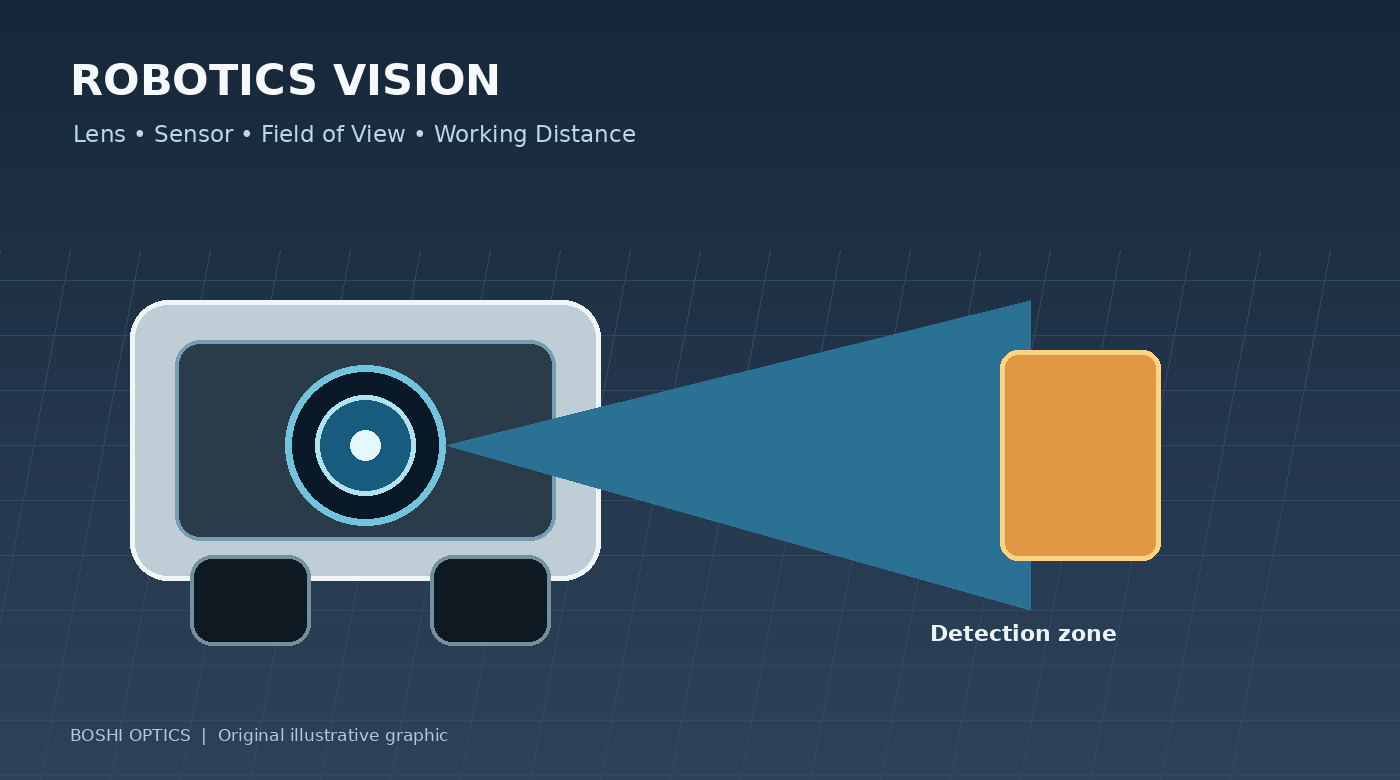
Field of view (FOV) describes the angular coverage of the camera. For robotics, it should be translated into a practical question: how wide an area must the robot see at the distance where detection or measurement takes place?
The answer depends on focal length and sensor dimensions, as well as the camera’s position and orientation. A lens that provides sufficient coverage when mounted high on a robot may not cover the same useful area when mounted close to the floor or behind a protective window.
Prepare a simple drawing with the camera position, target distance, and desired scene width and height. Include the nearest and farthest distances at which the system must work. This is particularly important when the robot approaches objects, turns in confined spaces, or works around shelves and machinery.
Do not select the lens based only on a diagonal FOV number if the algorithm relies on horizontal coverage or a specific region of interest. Ask for horizontal and vertical FOV under the intended sensor configuration, and verify the result in the assembled system.
4. Understand the trade-off between wide coverage and useful detail
A wider lens can capture more of the scene, but the same sensor pixels must represent a larger area. As a result, a small object may occupy fewer pixels and become harder to classify or measure.
Wide-angle lenses can also introduce geometric distortion. Distortion is not automatically a defect: it may be acceptable for general awareness or can sometimes be corrected through calibration and software. But if the robot needs accurate geometric measurements, distortion behavior and calibration stability deserve more attention.
The useful question is not “Is a wide-angle lens better?” It is “How much coverage is needed, and what is the smallest object or feature the system must recognize?”
For some robots, one camera cannot efficiently satisfy every task. A wide-view camera may support navigation while a second, narrower-view camera handles close inspection. Whether that architecture makes sense depends on cost, space, processing resources, and reliability requirements.
5. Consider motion, exposure, and lighting
Robots rarely operate in a perfectly controlled photographic environment. They move, vibrate, pass between bright and dark areas, and encounter changing illumination. A lens with a large aperture can help deliver more light to the sensor, but it does not eliminate motion blur or guarantee accurate detection.
Exposure time, sensor sensitivity, illumination, frame rate, and robot speed must be considered together. If the robot moves quickly, a short exposure may be needed to limit blur. That can require stronger illumination or a sensor with suitable low-light performance.
For indoor robots, flickering LED lighting, reflective floors, and changing daylight near windows may affect image consistency. Outdoor robots face additional challenges from direct sunlight, shadows, rain, and night operation. If near-infrared illumination is used, confirm that the lens and any filter configuration are suitable for the intended wavelength.
Test with representative lighting and movement whenever possible. A stationary bench image is useful, but it cannot reproduce every condition encountered on a moving platform.
6. Check the mechanical envelope and environmental requirements
Robotics cameras often have strict space constraints. Lens diameter, total track length, mount type, focus adjustment, sensor position, and the protective housing all affect whether a lens can be integrated.
A lens that fits the thread may still conflict with a cover, sit too far from the sensor, or be difficult to focus after assembly. If the camera sits behind a protective window, that window may also influence image quality and should be considered during system evaluation.
Environmental conditions matter too. A warehouse robot, outdoor inspection platform, and food-processing robot do not share identical requirements. Temperature range, vibration, dust, moisture, cleaning agents, and sealing requirements should be specified according to the actual use case rather than assumed from a broad label such as “industrial.”
Provide a mechanical drawing or a dimensioned sketch before committing to a custom design. It is usually easier to identify conflicts during the design stage than after the camera housing and lens samples have been built.
7. When is a custom robotics lens worth considering?
A standard lens is often the sensible choice when it meets the optical, mechanical, and commercial requirements. Customization becomes relevant when a project has a constraint that available catalog products cannot satisfy—for example, an unusual field of view within a small package, a special spectral requirement, a non-standard working distance, or a specific image-quality target.
Before beginning a custom project, collect the sensor datasheet, target FOV, working-distance range, available dimensions, lighting conditions, environmental limits, and estimated production volume. Share sample images or a sketch of the camera’s field of view if available.
These inputs help an optical team assess feasibility and identify trade-offs. They also make it easier to determine whether adapting an existing lens could meet the requirement at lower cost and with less development time.
Customization should solve a defined problem, not simply make the product different.
Conclusion: design for the task the robot must perform
Selecting a camera lens for robotics is a system-level decision. The sensor, field of view, target distance, distortion, lighting, motion, mechanical space, and operating environment all contribute to the result.
For a new robot platform, it is worth defining the vision task before finalizing the lens specification. For an existing system with inconsistent detection or insufficient detail, review the complete image path before assuming that the lens alone is responsible.
Boshi Optics, part of Shanghai Silk Optical Technology Co., Ltd., provides optical lens design and manufacturing for imaging applications, with standard and customized options across multiple product categories. If you are developing an AGV, inspection robot, or other vision-enabled device, share your sensor model, target coverage, working distance, mechanical constraints, and expected volume to start a practical lens discussion.
Explore our M12 lens range and customized optical products , or contact us through the Boshi Optics website to discuss your application.