

How to Choose an Endoscope Lens for Your Application
An endoscope lens has a difficult job. It must fit into a narrow instrument while producing an image that is useful at a short distance, often in a space where lighting and positioning are tightly constrained.
Choosing an endoscope lens is therefore not simply a matter of selecting the smallest available diameter or the widest field of view. A lens that captures a broad scene may show less detail per object. A design optimized for a particular working distance may not keep a much nearer or farther object in acceptable focus. Mechanical limits can also restrict the optical configurations available to the designer.
Whether the application is medical imaging, industrial inspection, or another form of internal visualization, the best starting point is to define what the camera must reveal and under what conditions.
1. Define the inspection task and target
Start by describing what the endoscope needs to observe. Is the goal to inspect a surface for scratches, examine a cavity, identify a small feature, or provide a general view of an internal space? The target and task determine which image characteristics matter most.
For a defect-inspection system, the ability to distinguish small details may be more important than capturing the widest possible scene. For navigation through a cavity or pipe, broader coverage may be useful. Some applications need both, which can require compromises or a different camera architecture.
Also describe the target material and surface. Highly reflective, transparent, dark, or textured objects can behave differently under the same illumination. If the endoscope will operate in a liquid or behind a protective window, mention that early; the optical path is not necessarily equivalent to an ordinary air-based setup.
Photos of the target, a sketch of the available space, and examples of acceptable versus unacceptable images are often more helpful than a short specification alone.
2. Field of view: how much can the lens see?
Field of view (FOV) indicates the angular extent of the scene captured by the lens. In endoscope applications, a wide FOV can help the user see more of the surrounding area without moving the instrument as much.
However, wider coverage is not automatically better. When the sensor resolution remains fixed, a larger scene may leave fewer pixels across a small feature. Very wide-angle designs may also introduce distortion, which may be acceptable for visual orientation but less suitable when geometry must be assessed accurately.
When specifying FOV, clarify whether the requirement is horizontal, vertical, or diagonal. State the sensor format or model, because the same lens can produce different coverage with different sensor dimensions. If a target must fit within the image at a defined distance, provide the target dimensions and working distance as well.
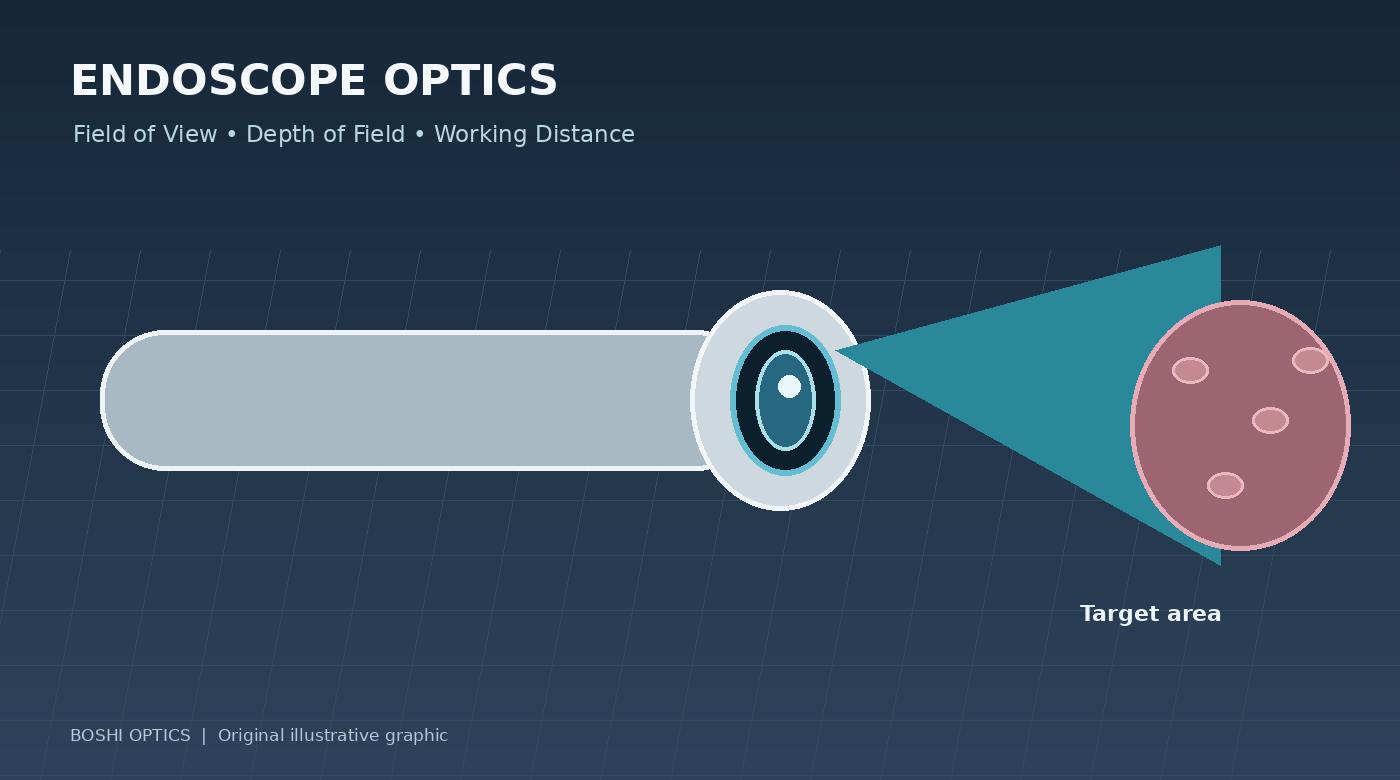
A simple drawing showing the lens tip, target, and required visible area can help the optical designer determine whether the proposed field of view is appropriate.
3. Depth of field and working distance are connected
Working distance is the distance from the lens or a clearly specified reference point to the target. Depth of field (DOF) describes the range of object distances over which the image remains acceptably sharp under defined conditions.
These two parameters should be discussed together. A lens optimized for a narrow distance range may provide strong detail at the intended inspection point but become less useful when the target moves closer or farther away. A larger depth of field may improve tolerance to distance variation, although the result depends on optical design, aperture, sensor resolution, and the criteria used to define acceptable sharpness.
For an endoscope, it is helpful to provide the nominal working distance, the nearest expected target distance, and the farthest distance that must remain usable. If the instrument must inspect both a nearby surface and a wider cavity, say so rather than providing only one preferred distance.
Avoid asking for “large DOF” without describing the actual operating range. A numerical distance range or a few representative target positions makes the requirement easier to evaluate and test.
4. Why the optical medium matters
An optical system designed for use in air may behave differently when used in another medium, such as water or a liquid-filled environment. The refractive index of the surrounding medium changes how light bends at optical interfaces and can affect focus, apparent field of view, and other imaging characteristics.
This is particularly important when an endoscope is intended for underwater inspection or another application where the front optical surface contacts a medium different from air. Testing a lens in air alone may not fully predict its final behavior in the intended environment.
When describing the application, specify whether the lens will operate in air, water, or behind a transparent protective window. Include the window material and thickness if known. If the system will be immersed, define the relevant working distances and the conditions under which image quality must be assessed.
The appropriate test setup should reflect the final application as closely as practical. For specialized projects, the optical team and customer should agree on the reference medium, target distance, focus procedure, and image-quality acceptance criteria before sample approval.
5. Diameter and mechanical design can limit the optical solution
Endoscope lenses often operate under demanding size constraints. The available outer diameter and total length affect how many optical elements can be accommodated, how the lens is assembled, and how it interfaces with the image sensor and surrounding housing.
A smaller diameter is not an isolated objective. It must be balanced against field of view, image quality, depth of field, illumination, and manufacturing feasibility. A design that is technically possible may still require trade-offs in performance, assembly complexity, or cost.
Provide the maximum outer diameter, available length, sensor location, mounting interface, and any restrictions on the front tip. If the endoscope includes illumination fibers or LEDs, include their position and the space reserved for them. These components can influence the mechanical layout and the light reaching the target.
A dimensioned drawing is ideal, but a clear sketch can support an initial feasibility discussion. Identify which dimensions are fixed and which could be adjusted if an optical trade-off is needed.
6. Resolution, illumination, and image contrast
The lens must deliver enough useful detail for the intended task, but the sensor and illumination also influence the final image. A high-resolution sensor cannot compensate for insufficient optical contrast, poor focus, motion, or inadequate lighting.
Endoscope imaging often involves restricted space for illumination. Brightness may vary across the scene, and reflective surfaces can create highlights that obscure details. The lens, sensor exposure, illumination geometry, and image processing should therefore be evaluated as a system.
When defining image quality, describe the feature that must be resolved, the target distance, and the area of the image where performance matters most. If you have a measurable requirement, such as a minimum feature size or a defined image-quality test, share it. If not, provide representative images and explain what the current system fails to show.
Avoid relying only on a megapixel label. Practical evaluation with the intended sensor, illumination, and target is essential before approving a lens for production.
7. What to prepare before contacting a lens manufacturer
A productive inquiry does not require a completed optical prescription. It does require enough information to assess the application.
Prepare the following where available:
Application and target type
Sensor model, active dimensions, or datasheet
Required horizontal, vertical, or diagonal FOV
Nominal and allowable working-distance range
Required depth of field or minimum feature size
Maximum lens diameter and available length
Operating medium, protective window, and environmental conditions
Illumination arrangement and wavelength, if relevant
Prototype quantity, expected production volume, target cost, and schedule
If you have an existing endoscope module, sample images or a physical reference may clarify what needs to change. Identify the current strengths and limitations: perhaps the image is sharp only at one distance, the tip is too large, or the scene coverage is insufficient.
This information helps determine whether an existing lens can be adapted or whether a customized optical design should be considered.
Conclusion: start with the real inspection conditions
Endoscope lens selection is a balance between optical performance and physical constraints. Field of view, depth of field, working distance, surrounding medium, sensor characteristics, illumination, and mechanical dimensions should be defined together.
The most useful specification is not necessarily the longest one. It is the one that describes the real inspection task clearly enough for engineers to evaluate a practical solution.
Boshi Optics, part of Shanghai Silk Optical Technology Co., Ltd., develops and manufactures optical products for imaging applications, including customized endoscope-related optics. For a new project, share the sensor information, mechanical envelope, working-distance range, target scene, and intended operating medium.
Visit our customized products page to learn more about customized optical development, or contact us through the official website (https://www.lensmanufacture.com/) to discuss your requirements.