

How to Specify a Thermal Imaging Lens: 7 Parameters Buyers Should Confirm
A thermal camera does not form an image in the same way as a conventional visible-light camera. It detects infrared radiation within a defined spectral band and converts the received signal into a thermal image. The lens must be designed for that wavelength range and matched to the detector and intended application.
For buyers, the challenge is that a thermal lens specification can contain several parameters that look familiar—focal length, F-number, field of view, and focus range—alongside requirements that are specific to infrared imaging. Selecting a lens by focal length alone can lead to an assembly that does not provide the expected coverage, sensitivity, or mechanical fit.
This guide outlines seven parameters worth confirming when sourcing a thermal imaging lens for security, industrial monitoring, inspection, or other infrared applications.
1. Confirm the detector format and pixel pitch
Start with the detector model whenever possible. At minimum, identify the detector resolution, active area, and pixel pitch. Common thermal detector configurations include different pixel counts and pixel pitches, and the lens must provide an image circle and optical performance appropriate to the detector.
Pixel pitch is the spacing between adjacent detector pixels. It is relevant to the spatial detail the system can sample, but it does not independently determine the final image resolution. Optical performance, focus, signal processing, atmospheric conditions, and target contrast also matter.
A lens designed for one detector format may not cover a larger active area. Conversely, a lens may physically cover the detector but fail to deliver the required image quality at the edges.
When requesting a quotation, provide the exact detector model or its datasheet. This allows the optical supplier to evaluate compatibility rather than relying on a description such as “640 × 512 thermal camera” alone.
2. Specify the spectral band and optical materials
Thermal imaging lenses must transmit the infrared radiation relevant to the detector and application. The long-wave infrared (LWIR) band is commonly associated with thermal imaging systems, but the required spectral range should be confirmed from the detector and system specification rather than assumed.
Optical materials suitable for visible-light cameras are not automatically suitable for every infrared wavelength. Material transmission, coatings, surface protection, and environmental requirements must be considered for the intended spectral band.
Clarify the required wavelength range and whether the lens must include an anti-reflection coating or protective front element. If the camera will operate outdoors, ask how the exposed optical surface is protected and what cleaning or handling restrictions apply.
Do not assume that “infrared lens” describes a single interchangeable product category. Near-infrared imaging and long-wave thermal imaging have different optical requirements. The exact band is one of the first details a supplier should confirm.
3. Choose focal length based on target distance and coverage
Focal length and detector dimensions together determine the angular field of view. In practical terms, the choice depends on how much of the scene the camera must cover and how far away the target will be.
A shorter focal length generally provides a wider field of view on the same detector, which can be useful for area monitoring. A longer focal length narrows the view and can place more pixels across a distant target, provided the optical system and atmospheric conditions support the required detail.
Before selecting a focal length, define the target distance, target size, required horizontal and vertical coverage, and whether the camera must observe both near and distant objects. A simple scene diagram is often helpful.
If the system must detect a small object at a known distance, the question is not only whether the target appears in the image. It is whether the target occupies enough detector pixels, with sufficient contrast, for the intended detection or measurement task. This may require system-level evaluation rather than a focal-length calculation alone.
4. Understand the F-number and its trade-offs
The F-number describes the ratio between focal length and the effective aperture diameter. In thermal imaging, a lower F-number can help the optical system collect more radiation, which may be valuable when detecting low-contrast targets or working with a limited integration time.
However, a lower F-number is not a universal solution. Optical design complexity, aberration control, lens size, cost, focus tolerance, and image quality across the field must also be considered. The detector, electronics, calibration process, and operating conditions influence the final thermal image.
When comparing candidate lenses, confirm the F-number alongside the required spectral band, detector, focal length, and field of view. Avoid comparing aperture figures without checking whether the products are intended for the same system requirements.
The appropriate aperture is the one that meets the sensitivity and image-quality targets within the project's size, cost, and manufacturing constraints.
5. Define focus range and minimum working distance
A thermal camera may be used for long-distance monitoring, close inspection, or a combination of both. The required focus range should therefore be stated explicitly.
Some applications focus at or near infinity, while others need to inspect equipment or components at shorter distances. A lens optimized for one range may not deliver acceptable performance throughout another. Minimum focus distance, focusing mechanism, and the possibility of focus adjustment should be confirmed before selecting the assembly.
If the camera will be installed behind a protective window, include the window in the system discussion. Its material, thickness, and placement may affect transmission or optical performance, depending on the spectral band and design.
Provide the closest and farthest target distances, and identify whether focus must be adjustable in the field or fixed during assembly. These details are particularly important for OEM equipment where the lens will be integrated into a sealed or compact housing.
6. Confirm field-of-view, distortion, and image coverage
A thermal lens should be evaluated for the required field of view and the portion of the detector that must remain usable. The nominal angle is only part of the picture.
Relative illumination, distortion, and optical performance across the field can influence how consistently targets appear from the center to the edges. For applications involving measurement, tracking, or automated analysis, distortion behavior and calibration may be especially important.
If the camera needs to cover a specific corridor, machine, electrical cabinet, or outdoor area, provide the scene dimensions and camera-to-target distance. Ask for the horizontal and vertical field of view, not only the diagonal value, when the application has a defined aspect ratio.
Also clarify whether the camera will be used for qualitative observation, automated detection, or temperature measurement. These tasks can place different demands on the complete imaging system. A lens specification should be tied to the intended outcome, not just to a list of optical numbers.
7. Check environmental, mechanical, and production requirements
Thermal imaging lenses are often used in demanding environments, including outdoor monitoring, industrial inspection, and equipment operating across a broad temperature range. Specify the expected operating temperatures, moisture exposure, vibration, dust protection, and any relevant sealing requirements.
Mechanical integration deserves equal attention. Confirm the mounting interface, lens diameter, total track length, detector position, available space, and focus adjustment method. If the design includes a protective front element or window, clarify its role and required properties.
For OEM projects, provide the expected prototype quantity, estimated annual volume, target unit cost, and project schedule. These commercial inputs help the supplier determine whether a standard lens is appropriate or a customized design should be evaluated.
Finally, define how samples will be assessed. The detector, lens, calibration, and test environment should be consistent with the intended use. Agree on the test distance, focus procedure, target conditions, and acceptance criteria before mass-production approval.
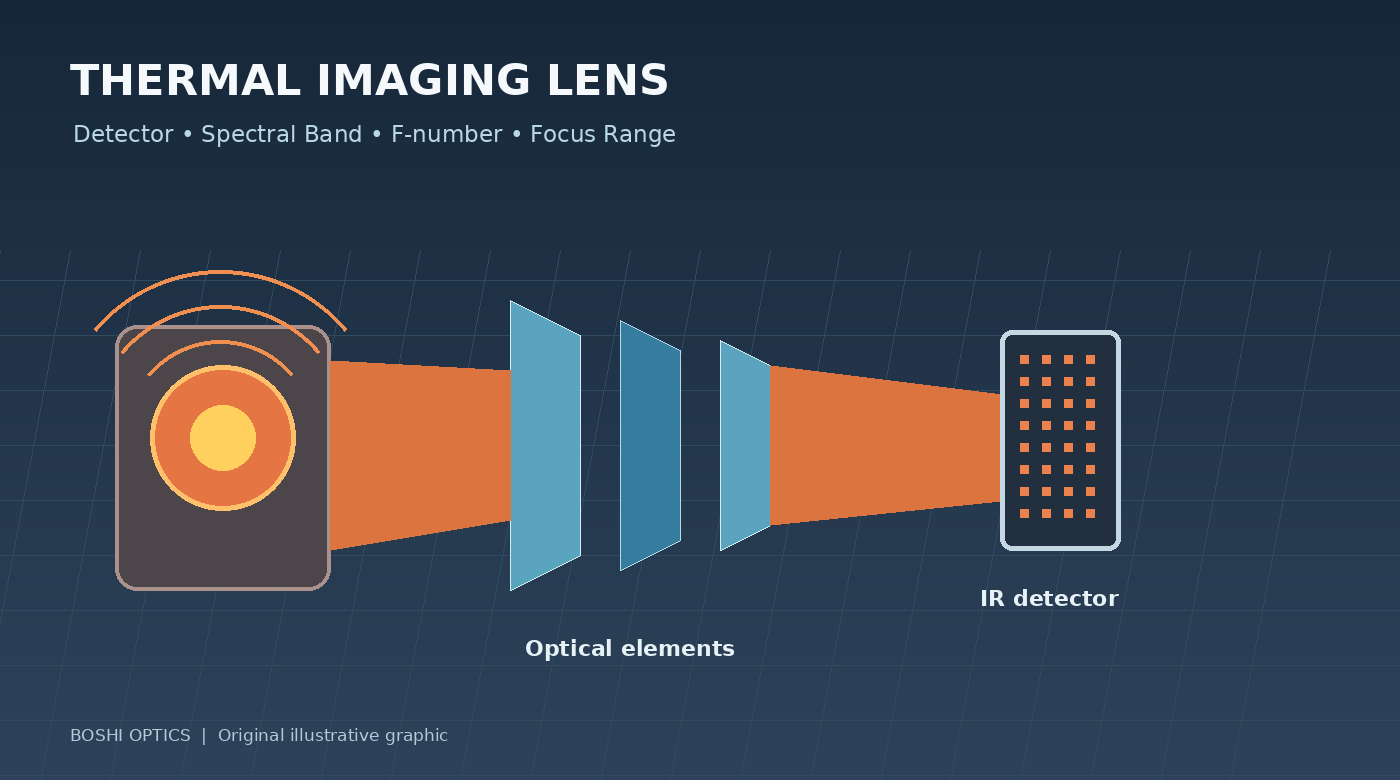
Conclusion: specify the whole thermal imaging system
Choosing a thermal imaging lens requires more than matching focal length or F-number. Detector format, pixel pitch, spectral band, field of view, focus range, optical performance, mechanical constraints, and operating environment all influence whether the lens is suitable.
A complete detector datasheet, target-distance information, scene requirements, and mechanical drawing provide a much stronger basis for evaluation than a short request for a “thermal lens.”
Boshi Optics, part of Shanghai Silk Optical Technology Co., Ltd., offers optical products for imaging applications, including thermal imaging lens options and customized optical development. If you are sourcing a lens for a new thermal camera, share the detector model, spectral band, required field of view, focus range, and available mechanical dimensions.
Explore our thermal imaging lens products and customized optical solutions , or contact us through the Boshi Optics website to discuss your application.