

The 4K Era is Here: Why Your Security System Must Upgrade from 5MP to an 8MP Lens
The Physical Bottleneck: Starving Your 4K Sensor
One of the most common logistical errors we see on the Bill of Materials (BOM) is an engineer matching a premium 4K (8-megapixel) image sensor with a legacy 5MP lens to save a few dollars. The logic usually goes: "The sensor is 8MP, so the output video will be 4K." This is fundamentally flawed. Megapixels only dictate the sensor's capacity to receive data. The optical resolution of the lens—measured in line pairs per millimeter (lp/mm)—determines how much clear detail actually makes it to the sensor.
A lens designed for 5MP has physical limitations in its glass curvature and material. If you put a 5MP lens in front of an 8MP sensor, the sensor is working overtime to capture light that is already optically blurred. You will generate massive 4K video files, but the actual footage will look like pixelated 1080P. To get true 4K output, you physically need an 8MP lens capable of resolving that extreme level of detail.
The Real Value of 4K: Flawless Digital Zoom
In modern B2B security and machine vision, the goal of 4K isn't just to watch a wider screen; it is the ability to use digital zoom without destroying the image.
-
Standard Scenarios: A 5MP lens might read a license plate perfectly at 10 meters. But at 20 meters, the characters become a soft blur.
-
The 8MP Advantage: An 8MP lens paired with a 4K sensor captures an immense amount of pixel density. Security personnel or AI-ISP algorithms can digitally crop and zoom into the far corner of a parking lot to identify a face or read a container number, with the details remaining razor-sharp.
If your lens tops out at 5MP resolution, that digital zoom advantage is completely lost.
Edge Sharpness and CRA Control
When we talk about 8MP, we aren't just talking about the dead center of the frame. The true test of a 4K optical system is what happens in the corners.
Because 8MP sensors pack millions of microscopic pixels into a standard 1/2.7" or 1/1.8" format, the angle at which light hits the outer edges is critical. If a lens has a poorly controlled Chief Ray Angle (CRA), light will strike the edge pixels too sharply, causing severe color fringing (chromatic aberration) and soft, blurry corners.
A genuine 8MP lens is engineered with advanced optical formulas—often utilizing high-refractive-index glass or precision-molded aspherical elements—to keep the CRA optimized. This guarantees that an intruder in the extreme bottom-left corner of the camera feed is just as sharp as one standing dead center.
The Engineering Economics: Future-Proofing Your BOM
Historically, 4K adoption was slowed by expensive hardware and massive storage requirements. Today, H.265+ encoding has solved the bandwidth problem, and sensor prices have dropped dramatically.
The most expensive part of a security deployment is no longer the camera itself; it is the labor required to install and maintain it. Saving a few dollars on a 5MP lens today guarantees that you will have to pay a technician to climb a ladder and replace the entire unit in two years when the client’s AI software fails to read the blurry footage.
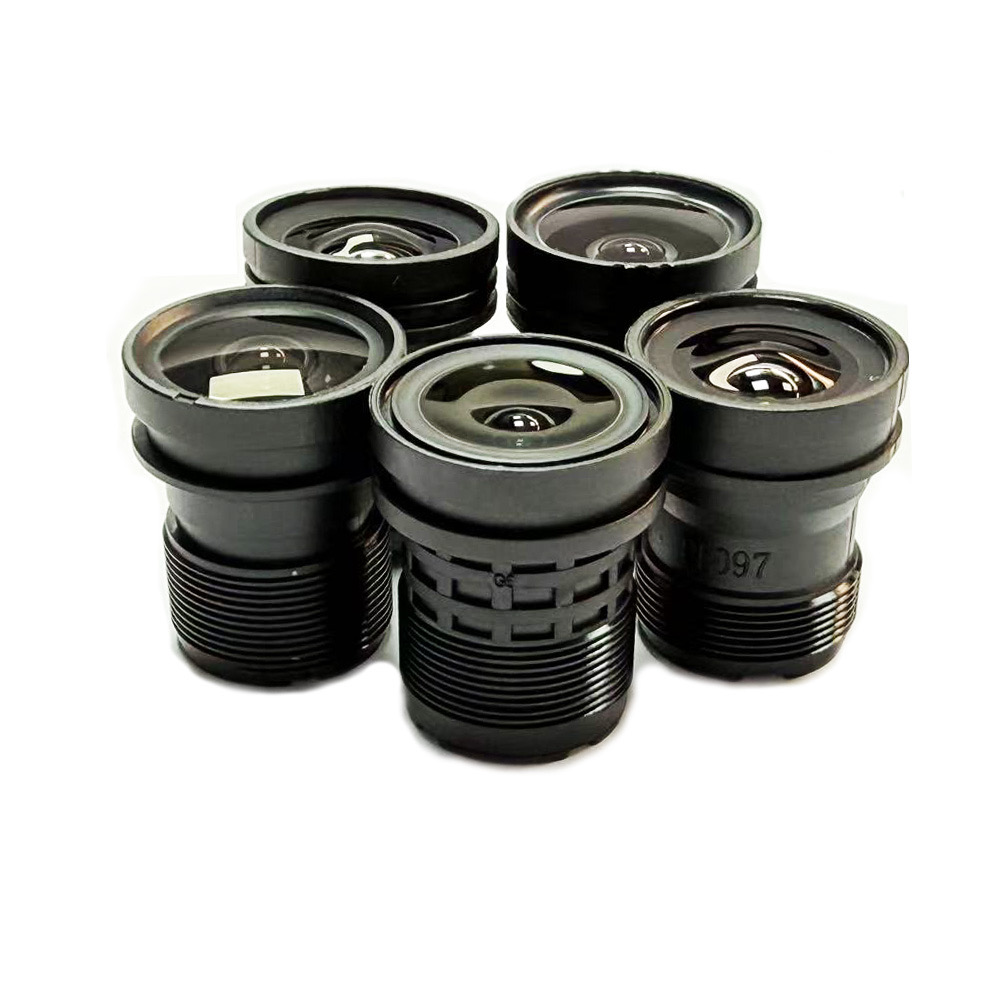
Upgrading to an 8MP lens immediately future-proofs your hardware. At Shanghai Silk Optical Technology Co., Ltd., we manufacture high-precision 8MP M12 lenses designed specifically to eliminate optical bottlenecks, ensuring your 4K systems deliver the exact mathematical clarity your algorithms demand.